
Grimes Is at His Exercise
Peter Grimes as deposition, Disney hero, Billy Joel, nihilist penguin, and Jesuit
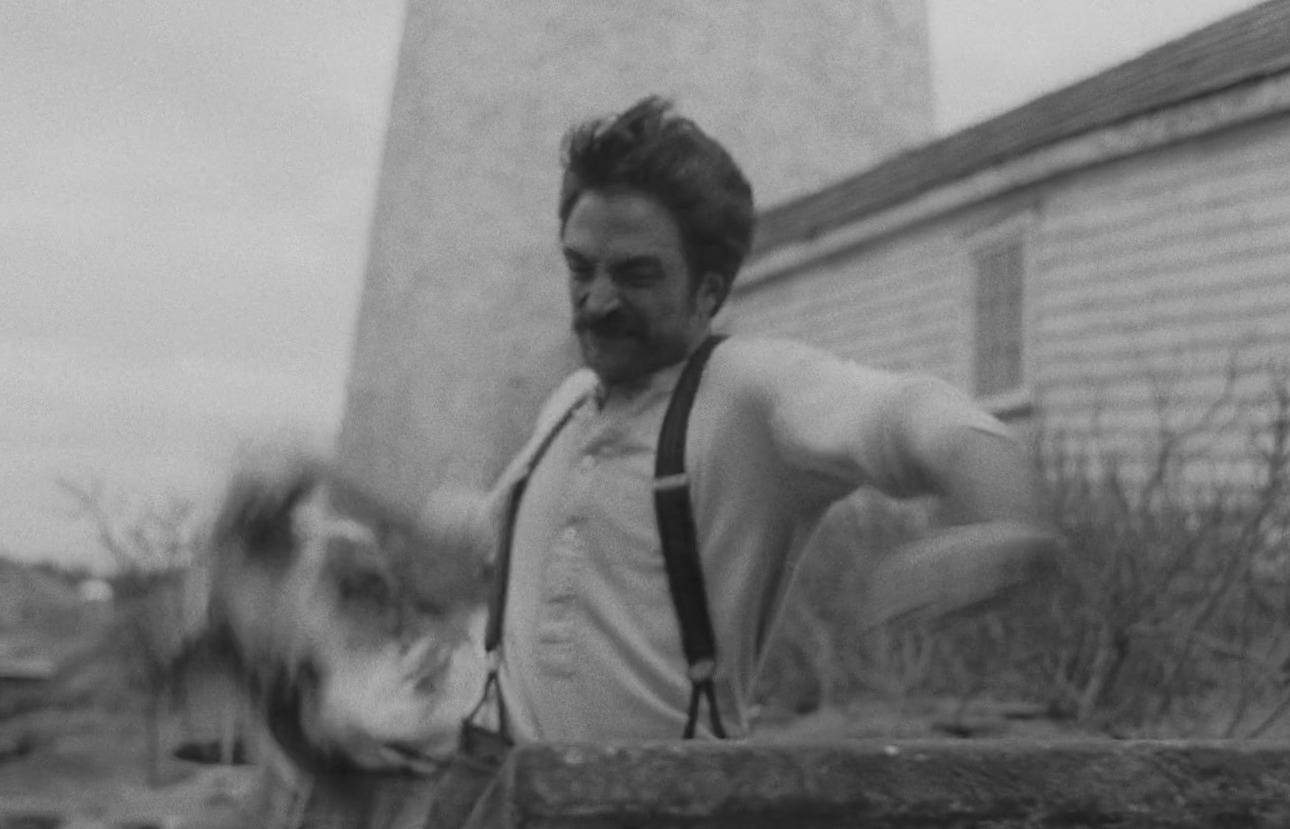
On this week’s episode of Decanonized, I’m joined by one of my favorite musicologists and musical thinkers, Imani Mosley, to talk about the only Benjamin Britten opera on Henry W. Simon’s list, Peter Grimes. Simon gives us five Menotti operas, but just one Britten, of which he writes: “It is a masterly piece of writing, but it is difficult to take warmly to one’s heart. One reason may be its sombre, rather repellent subject matter; another may be the involved, almost tortured language of the libretto.”
I worry about sending too many emails via Substack, because we have emails at home, and have another post to share in the coming days. Which is also why I don’t send around new episodes of Decanonized when they publish, though there is always, for me, more to say about these works. Revisiting this interview in particular (which I recorded with Imani last summer on a blazingly humid Monday evening in a booth in Friedrichshain), I was full of thoughts that I wish had come to me in the moment.
Can any of us ever say everything we want to say about a single work of art? (I suppose not given how many books we have about these operas.)
Peter Grimes with Imani Mosley

Is Peter Grimes the villain, or just his town’s biggest HR violation? Musicologist and Britten scholar Dr. Imani Mosley joins us to discuss the original problematic Grimes.
Prologue
In discussing Britten’s life in the years leading up to World War II, Imani and I touched on February House, the proto-polycule that saw Britten, Peter Pears, WH Auden, Gypsy Rose Lee, Carson McCullers, and Jane and Paul Bowles all living under one roof in Brooklyn Heights. It’s the Real World/RHONY franchise we never got, although Gabriel Kahane’s February House comes close to approximating the chaos.
Gabe makes another cameo in the world of Peter Grimes. In the final weeks of 2019, around the time that Fiona Hill was testifying as part of Donald Trump’s first impeachment hearings in the final weeks of 2019, Chris Thile decided to bring another deposition to the public: the Prologue to Peter Grimes. Performed as part of an episode of Live From Here, it features Kahane on piano as Hobson and Swallow, Thile as a mandolin-plucking Grimes, and Aoife O’Donovan as Mrs. Sedley and the Chorus (along with bandmates Mike Elizondo, Eric Doob, Alex Hargreaves, and Armand Hirsch).
It’s a delightful mix of Britten nerdism, a slight twang of the absurd, and a deeper resonance: As Imani and I discuss on the episode, Peter Grimes opened in May 1945, a month after VE Day and amid no small amount of anxiety and ambiguity for a Britain emerging from the blitz and entering austerity amid a collapsing empire and redefined national mythology. I’d argue that the US was nothing like post-war Britain in 2019, but given everything that happened in the months and years following this performance, it’s edging closer to that same zip code.
At least Britain was, in the case of World War II, on the right side of history.
And history shall call them…
I still can’t get over the fact that the Cambridge Opera Handbook for Peter Grimes was published in 1983, references the Britten-Pears Archive, and yet it still refers to Peter Pears as Britten’s “friend.”
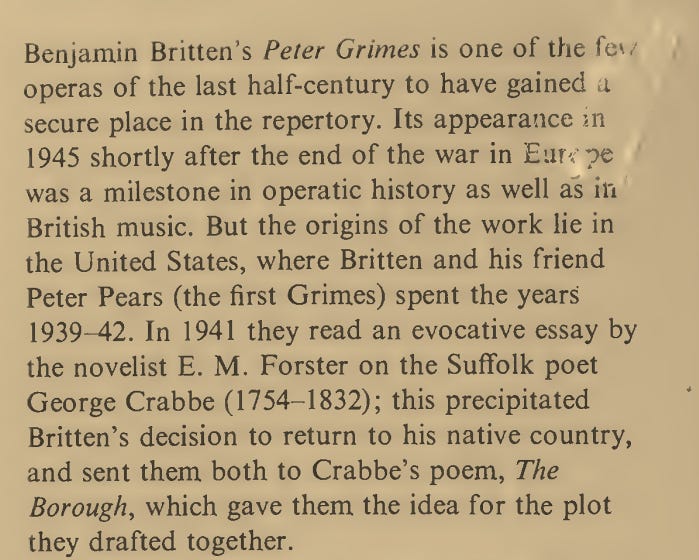
It also reminds me of Kashi’s Good Friends cereal boxes and makes me yearn for a Britten-Pears Kashi cereal box. Especially one that could somehow incorporate this photo of Britten.
Speaking of revisionism
Watching a BBC feature on Benjamin Britten, I did a double-take when the narrator describes Grimes as being tortured by “false accusations of murder.”
Whether or not Peter Grimes is directly responsible for the deaths of his apprentices, either by killing them with his own two hands or by being a walking OSHA violation, I can’t take the idea of him as some holy fool who has never done anything wrong. That’s directly contradicted in the libretto, not just by the townspeople writ large, but by Ellen herself.
So what does it say about the person who watches Peter Grimes and sees Parsifal? And what would happen if we were to show them Britten’s actual holy fool opera, Billy Budd?
Peter Grimes as lost Disney franchise
As Imani says on the podcast, Peter Grimes and Ellen come together out of a shared sense that both can have something better than what’s on offer in their tiny fishing village. This is ultimately their undoing as two characters who both want aren’t the same as two characters who share the same want. (Once again begging opera characters to have one normal conversation.)
But give Montagu Slater’s libretto a slightly different frame and you have a lot of the same classic tropes that shape a Disney animated feature. What are “Now the Great Bear and Pleiades” and “Embroidery in Childhood” if not two amped-up “I Want” songs? What is the final chorus, of the townspeople going on about their lives as if Peter never even existed, if not the bummer version of “Bonjour!” from Beauty and the Beast?
Given how easily Disney has revised other pieces of literature and history (see: The Little Mermaid, Pocahontas, Hunchback of Notre Dame, and what really happens to the stepsisters at the end of Cinderella), it’s surprising they haven’t tried to retrofit Peter Grimes into a franchise.
As the only other character who actually talks to Grimes, Balstrode is an obvious candidate for animal sidekick. Make him a black cat and revise Grimes’s fatal flaw to be that he’s the unluckiest fisherman in Suffolk, which leads to he “false accusations of murder.” Give us three gossiping harbor gulls that are half-Greek chorus, half-Andrews Sisters, all merchandising opportunity. Give us Lin-Manuel Miranda as the Great Bear and the entire cast of Euphoria as the seven Pleiades. Give us Robert Pattinson circa The Lighthouse as Grimes and Amanda Seyfried as Ellen.
This summer: Follow your heart beyond the horizon.
Summer, Aldeburgh Beach
Because I also have Brad Mehldau on Billy Joel fresh in memory, revisiting the moment after the mad scene where Ellen realizes she and Peter can never get on the same page this week put me in mind of a line from one of the supposedly 1.5 songs Joel writes:
“How thoughtlessly we dissipate our energies
Perhaps we don’t fulfill each others fantasies
And as we stand upon the ledges of our lives,
With our respective similarities
It’s either sadness or euphoria”
And what is the entirety of Peter Grimes if not a precursor to “The Downeaster Alexa”?
Sola e lontana
I sincerely doubt that Britten was fashioning an homage to Alfredo Catalani with “Now the Great Bear and Pleiades,” but I can’t hear the opening of that aria—each syllable attached to an E (apparently a favorite note of Peter Pears) that remains in stunned suspension—without also hearing the first phrase of “Ebben? Ne andrò lontana” from La Wally.
Wally’s aria, in which she threatens to run from home, sola e lontana, if she cannot marry the man she loves, also begins on a single, suspended, syllabic note (in this case B). In her case, the music soon melts into full expression, like the kid sister to “Vissi d’arte.” The note is far more friendly for a soprano, versus the delicate, passaggio setting of an E above mid-C for the tenor, but the unresolved nature of both notes shadow the rest of the aria with an unsettling chiaroscuro.
Both Peter Grimes and Wally are, at least in this moment, held in emotional stasis; two outsiders confronted by the vastness of the natural world, but already realizing that their fates are narrowing in on a single point. Grimes dies at sea, scuppering his boat in the howling North Sea. Wally dies in an Alpine avalanche (perhaps one of the reasons that opera doesn’t get staged very often).
It’s as if the human world is too cruel to bear and nature has to take over. Hard.
Relatable (or, Peter Grimes as nihilist penguin)
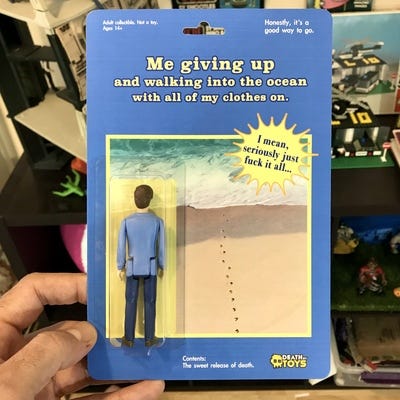
As someone whose father actually did walk into the sea and never walk out, I find something darkly hilarious about this idea having gained meme status in our current zeitgeist, to the point that there is even an action figure, called Me Giving Up and Walking into the Ocean with All of My Clothes On (“Contents: The sweet release of death.”). Aptly, the figure looks a bit like my dad.
I have a folder of these memes saved on my phone: “Hate your job? Hate your family? Have problems? Need to leave?” reads one, the text superimposed over the photo of a storm-hued shoreline. “Go there! Step into it and never leave! Go in the wet. The wet will love you. No problems in the wet. Just water. It’s salty! The wet doesn’t have capitalism. Just go in the wet.”
“The male urge to traumatise my wife and family, and mysteriously disappear at sea,” reads another, with an old-timey drawing of a ship caught among either rocks or glaciers.
This urge is on the same level as the cult status recently gained by a penguin in a 2007 Werner Herzog documentary. The disoriented or deranged bird breaks away from his colony and starts to head towards the Antarctic mountains, 70 kilometers away. A researcher at the camp tells Herzog that catching the rogue sphenisciform would be futile, as he would simply head back towards the mountains.
“The rules for the humans are, do not disturb or hold up the penguin. Stand still, and let him go on his way,” Herzog drones in his singular brand of Mitteleuropean nihilism. “And here, he’s heading off into the interior of the vast continent. With 5,000 kilometers ahead of him, he’s heading towards certain death.”
For some time now, we as humans have been on a trajectory towards our Penguin Derangement Year, where the most rational option to the increasing absurdity of life is to run for the hills or into the sea.
Yet, writing about the nihilist penguin in 2017 for Little White Lies, film critic Tim Cooke notes that the derangement narrative is Herzog’s, not the penguin’s. “The natural world, as we learnt from the horrors of Grizzly Man, is not easily compared with ours. The structures we adopt for our stories—be they tragic, romantic or comedic—do not fit nature quite so tightly, and Herzog knows this.”
Likewise, Camus would argue that self-annihilation isn’t the correct response to the absurdity of the world, but rather to rebel against that absurdity by living with passion and intention. It’s for a similar reason that Camus was drawn to the theater, finding in the artifice of staged works an inherent truth missing from real life.
This picture, of Peter Grimes not as a true rebel (as one would expect him to be in a world where virtually no one understands him) but, in the end, a conformist—surrendering to the life he felt he was beyond when finding it increasingly impossible to live as fully as he ought—is the perhaps most heartbreaking part of his story.
Grimes as a Jesuit ethnomusicologist
In 1911, Dutch physicist Heike Kamerlingh Onnes discovered that when mercury is chilled to a cryogenic temperature (the sort that can make the coldest day in Antarctica seem balmy by comparison), the element lost all electrical resistance, allowing a current to flow indefinitely and without energy loss.
How perfect, then, that the late Paul Pelkonen would christen his own music blog Superconductor nearly a century later. Himself a current with indefinite energy, Paul was one of my favorite people to run into at a performance for his Falstaffian personality and his genuine care about his colleagues as humans rather than resources.
Paul and I also both happened to attend Fordham as undergrads, in separate years but both under the tenure of Dean Robert Grimes. To this day, I can’t think about Peter Grimes without remembering a story Paul told, often, about meeting Dean Grimes as a student. Unable to resist, Paul sang the dramatic Britten line: “Grimes is at his exercise.” The reference wasn’t lost on Dean Grimes, who had a doctorate in ethnomusicology.
I look forward to listening to the episode!
I don't think it was uploaded on Patreon?
Isn't there a theory that Grimes is a repressed homosexual?
Follow up on the Live from Here clip, Punch Brothers has been doing arranged versions of the Four Seasons Interludes on their show Energy Curfew Music Hour and on tour.