
Two or Three (Other) Things I Know About I Puritani
The kinky and the Kinski
Previously on Two or Three Things I Know About…: Verdi’s Il Trovatore
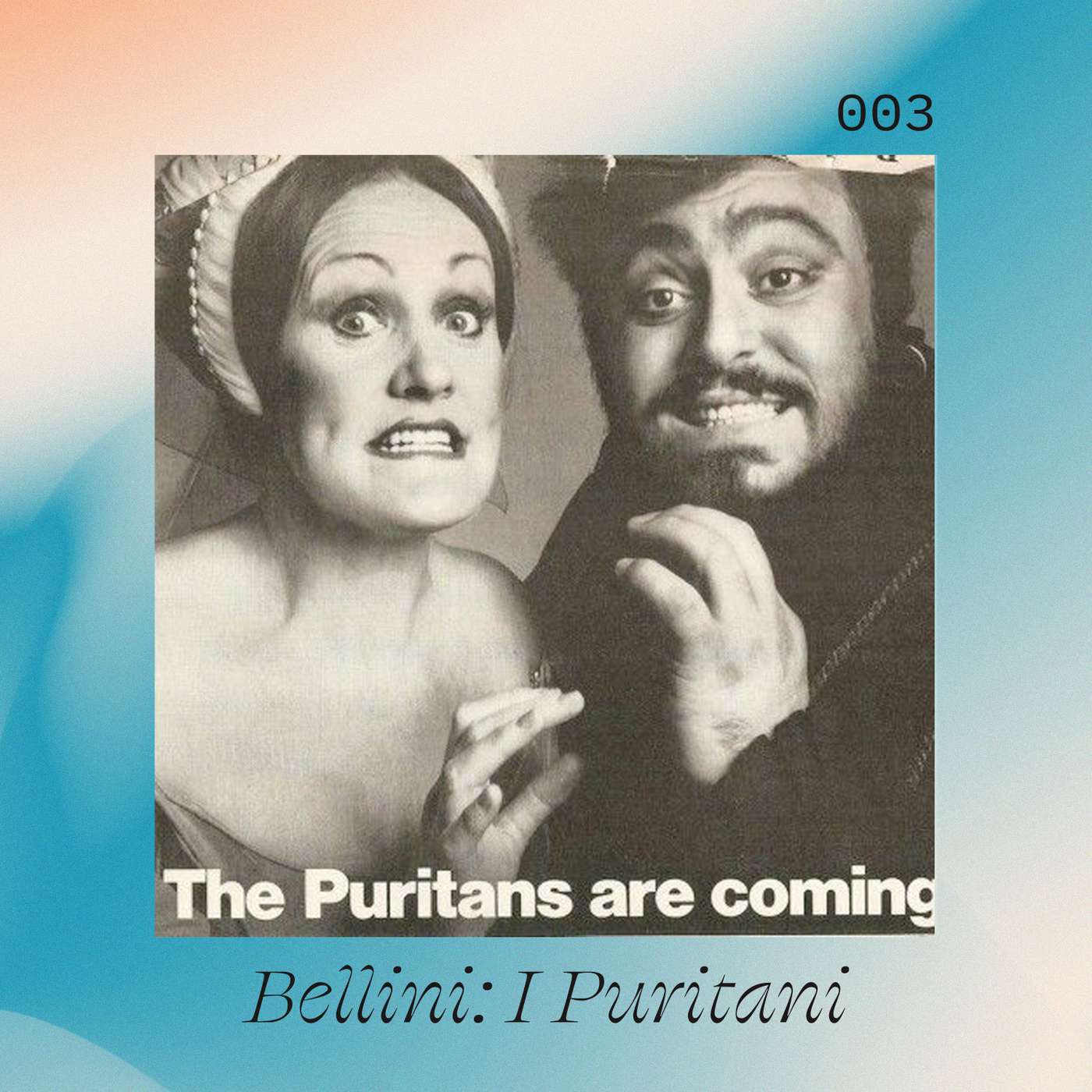
In last week’s episode of my new podcast, Decanonized (available wherever you get your podcasts, and now also available on Substack!), I discussed Bellini’s I Puritani with my friend and fellow critic, Aksel Tollåli.
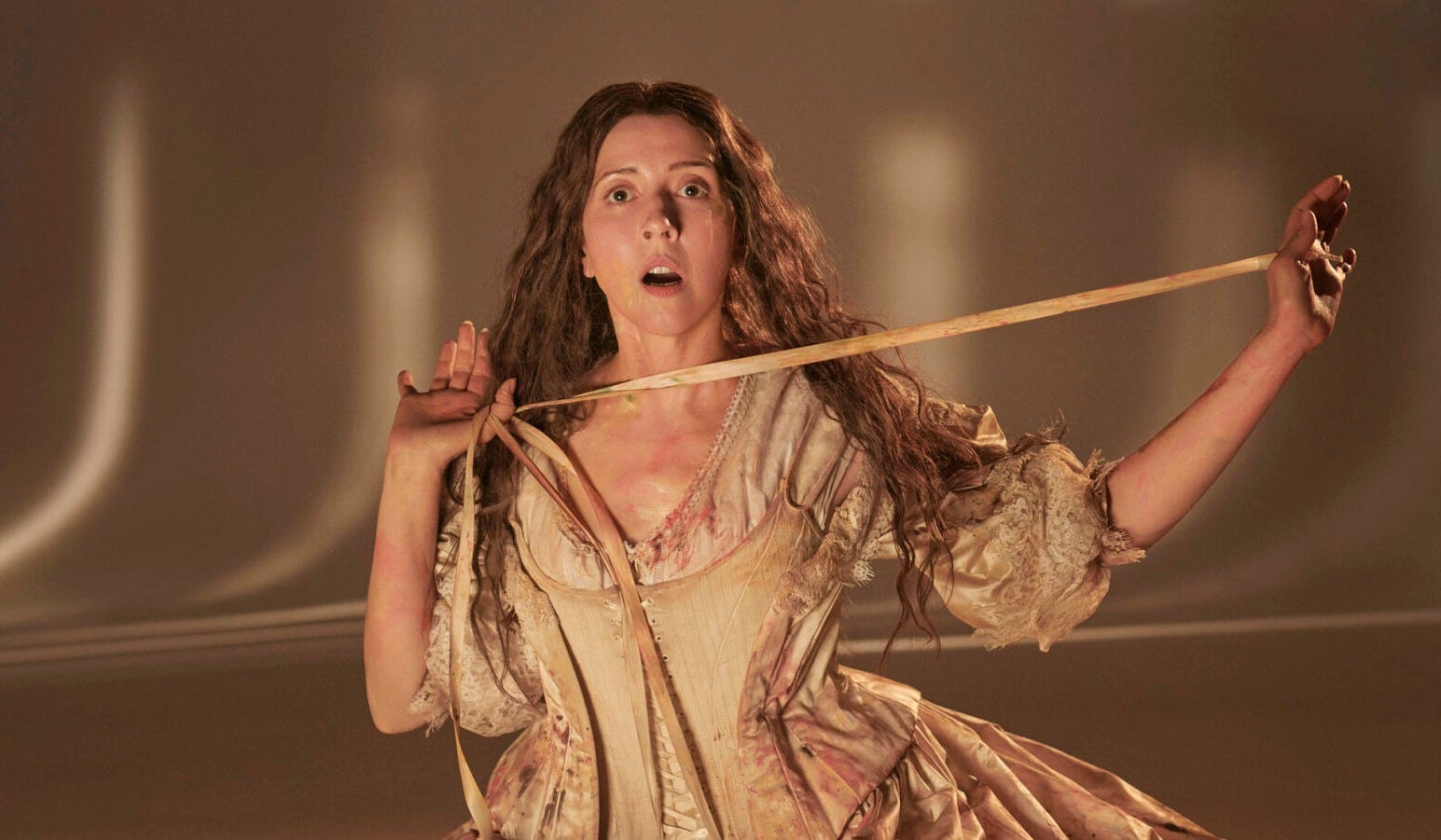
Aksel and I spoke about Puritani last summer, sadly long before the Met premiered its new production with Lisette Oropesa, although her wonderful recording of the work is referenced plenty.
One thing I forgot to bring up on our call was a review of the work from none less than Edward Said. I thought about re-recording that part of the episode, but the more I thought about the Said quote, the more I thought about how it fit with a larger reading of a Puritani we might have gotten, had its composer and librettist been closer to the same page.
I.
In his 2020 special, Alive from New York, Pete Davidson recalls the reaction his friends had to “Thank U, Next” — Ariana Grande’s pop anthem that referenced her breakup with the comedian: “That song came out and my friends were like, Bro, I love you. I love you, right?… Shit is catchy. Shit is very catchy.”
I feel the same way listening to I Puritani given what Edward Said wrote of the work in an 1987 column for The Nation:
“What an odd, even kinky spectacle this opera presents, with its interminable vocal acrobatics, its vacant plot, its pointless allusions to seventeenth-century England. At its center stands a fluttery teenager who has gone ‘mad’ in her love for a man she thinks has betrayed her; the lovers’ music is based upon an inhumanely elongated treble melody set above an unabatedly monotonous and minimal bass, punctuated by militaristically concerted brasses. Exhibitionist display, an utterly precious and exhausting idiom, endlessly forestalled climaxes, men’s and women’s voices rising and falling indiscriminately in constant imitation of each other: This surely adds up to a vision of sexuality that requires some skeptical attention, not least for its enduring capacity to captivate large audiences of men and women.”
I love Edward Said. But… the shit is indeed very catchy.
One of the major issues in Puritani’s vacant plot owes to the adaptation process. “I am about to lose my mind over the plot of the opera for Paris, as it has been impossible to find a suitable subject for my purpose and adaptable to the company,” Bellini wrote to friend and fellow composer Francesco Florimo in the spring of 1834. A month later, on April 11, he and librettist Carlo Pepoli had settled on adapting a play that had shown the previous season in Paris: Jacques-François Ancelot and Joseph Xavier Boniface’s Têtes Rondes et Cavaliers (“Roundheads and Cavaliers”).
Bellini was likely attracted to the work for the mad scene potential with its heroine. But librettist Carlo Pepoli was less interested in the mad scene as he was with the other surrounding circumstances, many of which don’t make it into the libretto for I Puritani.
One of the major shifts is in what would become the character of Riccardo, known in Têtes Rondes as Mulgrave. Mulgrave is far more adamant about marrying Lucy (who becomes Elvira in Bellini’s world). He argues this point directly with Lucy’s father, who says he doesn’t wish to force his daughter into a marriage against her will. The union between Lucy and Arthur, however, has political dimensions that are made explicit in Têtes Rondes, along with the political actions of Lucy’s father, who happens to be governor of their local fortress.
Despite his own identity as a Presbyterian, Mulgrave has a powerful ally in another character excised from Têtes Rondes for I Puritani, Puritan soldier Pembroke (who at the beginning of the play changes his name, improbably, to Jeroboam Habakkuk).
The story is also much less about religious factions and more about political alliances. Mulgrave is a Presbyterian (Lucy is also seemingly not puritanical), and finds a powerful ally in the uber-Puritan Pembroke (who changes his name at the beginning of the play to Jeroboam Habakkuk in honor of the two prophets—and yet they never give him a mad scene). After Arthur escapes with Queen Henriette, Mulgrave is able to leverage this into Lucy’s father falling from political grace. He becomes governor and maintains hope that Lucy will marry him, even if she remains out of her mind.
Lucy and Arthur are reconciled in the second act, and much of the third act involves a more cogent Lucy working the levers of politics to have her fiancé exonerated so that they can be together. This succeeds, but Mulgrave has his revenge: Arthur is forcibly exiled from England. Lucy goes with him; they are together, but separated from their home.
It’s easy to understand why Pepoli was attracted to this plot: The son of a wealthy Bolognese dynasty, Pepoli was involved with the political revolutions that occurred in northern Italy just before the Risorgimento came together. He was serving in a provisional government in Romagna after the 1831 uprising and for that he was imprisoned in the infamous Spielberg.
It wasn’t until France intervened that Pepoli was able to flee to Paris, where he fell in with his fellow Italian exiles. He met Bellini through the salon of Cristina Trivulzio Belgiojoso, another unwilling exile whom Mary Ann Smart describes as “by far the most overtly political of the salonnières.” The parallels between Cromwell’s England and the Italy Pepoli had been forced to flee in 1831 were clear: the societies were both marked by political repression, the constant threat of arrest or exile, and private lives shaped—and often destroyed—by ideological conflict.
Bellini, however, wasn’t an exile, and was planning on bringing I Puritani to Naples after Paris, which would require the approval of one of the more tough censors in Italy at the time. In Smart’s words, he “responded with alarm to the hot-headed patriotism of Pepoli’s poetry,” complaining of “a liberal bent that terrifies me.” His constant pushbacks against Pepoli led to one of his most enduring lines about opera: “Carve it in your head in adamantine letters: Opera must make people weep, feel horrified, must kill through singing.”
Despite this level of micromanagement, Pepoli was able to get in a plea for “libertà,” and it lives in one of the opera’s most popular moments: “Suoni la tromba e intrepdio.” In this, Riccardo and Giorgio (an invention on Pepoli’s part to replace the excised role of Lucy/Elvira’s father) sing: “Bello è affrontar la morte, gridando: ‘Libertà!’” How beautiful to greet death by shouting “freedom!”
II.
To go back to Edward Said, I wonder how he would have felt about a Puritani that was more driven by Pepoli’s agenda than Bellini’s. Given his general ambivalence towards bel canto (except for Rossini), my guess is his opinion wouldn’t have changed much, even with the revolution and exile. But Pepoli’s read on Têtes Rondes is very much in line with Said’s assertion that “appeals to the past are among the commonest of strategies in interpretations of the present.”
It’s also in line with Said’s argument that the battle of imperialism is not only over land, but also over narrative—who gets to narrate, which narratives are permitted—to the point that narrative itself is a weapon in this battle. “Most important,” he adds, “the grand narratives of emancipation and enlightenment mobilized people in the colonial world to rise up and throw off imperial subjection.”
Pepoli would have agreed. “If music and poetry work in concert, they can vanquish any listener,” he told a group of students in 1830 at Bologna’s Liceo Musicale. “The proof lies in the Marseillaise. Without the music, the poetry is not beautiful; without the poetry, the music is not complete. When the poetry and music are joined, it becomes a superb composition. For that, the people fought, vanquished, triumphed. Europe and the world shouted, ‘Liberty!’ This is the most important event that can be narrated in the modern history of music.” As Smart notes, in its original Italian, Pepoli’s line, “shouted ‘Liberty’!” presages his line in “Suoni la tromba”: gridano “Libertà.”
This isn’t the Puritani we have. Was it the Puritani we deserved? I’m not sure. It’s certainly one that would have been a revolution in Naples had Pepoli gotten his way. And perhaps “Suoni la tromba” was enough for Giuseppe Verdi to write Nabucco and the even more Risorgimento-coded opera, La battaglia di Legnano. Of course, Verdi would then support an empire by writing Aida for Khedive Ismail Pasha of Egypt. Shortly thereafter, Italy itself would become an empire, joining in the late-19th-century land grab for Africa.
Funny, too, is the reaction that Said’s criticism of Puritani has received. The essay it’s taken from, about music and feminism, is included in Music at the Limits, a posthumous collection of Said’s music criticism that was published in 2009. A few years later, a review of the German edition by Jens Rosteck cites this almost parenthetical line as part of Said’s “slur[ring of] the entirety of Italian opera as second-rate,” and labeling him “a sworn enemy of the bel canto repertory in general.”1
Can the subaltern have an opinion?
III.
I Puritani’s most famous cultural reference (apart, perhaps, from the time that Lee Pace played Bellini off-Broadway) is found in the likely-unlikely source of Werner Herzog. How apt, then, that 1982 Pauline Kael’s review of Fitzcarraldo presages Edward Said’s later writings on Puritani:
“After a visually promising beginning, Herzog seems to lose interest in the external world (and no one in this movie has much of an internal world, either). The shots are repetitive and are held too long, and though they’re lovely, they don’t have the ghostly, kinky expressiveness of the great images that sustain one through the dragginess of Aguirre.”
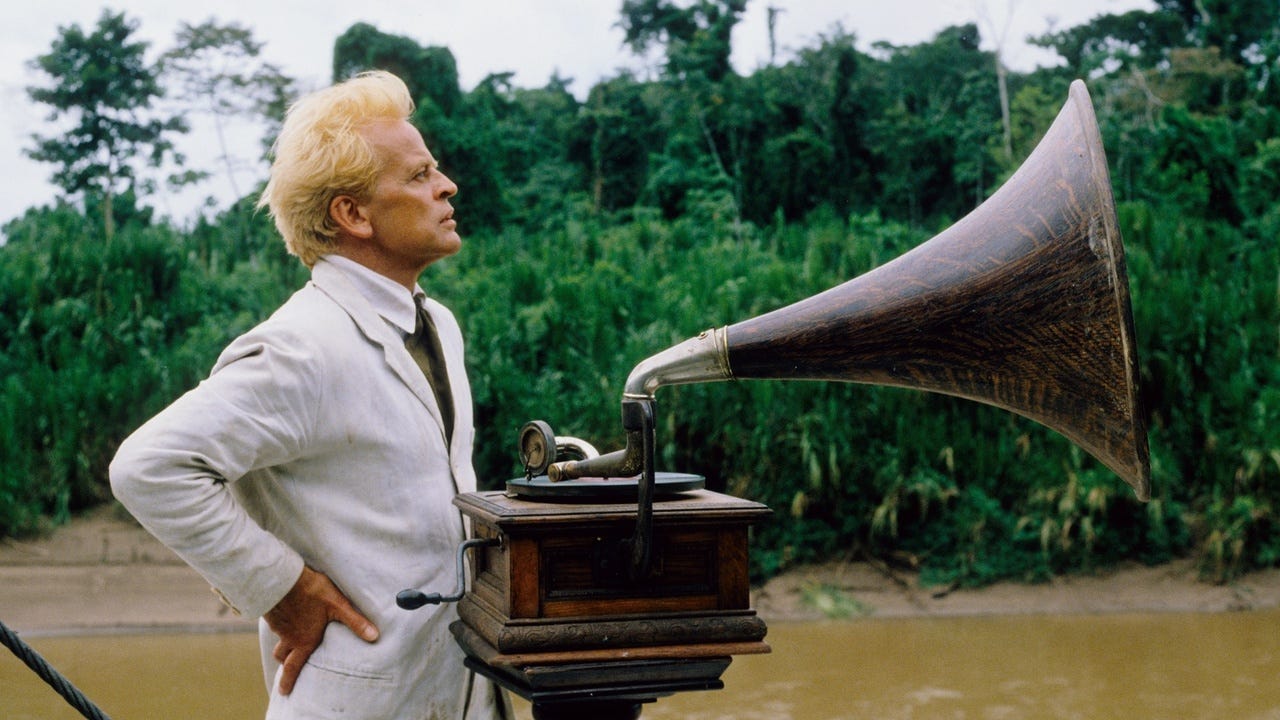
What an odd, even kinky spectacle it is to watch Fitzcarraldo today. Klaus Kinski plays the titular conquistador, an Irish immigrant in the Peruvian city of Iquitos during the Amazon rubber boom, intent on building an opera house in his new adoptive city. Kinski’s failed attempts to realize this Xanadu play out over nearly two maddening hours, most of which I spent wishing that Herzog had taken the indigenous Matsigenkan extras up on their offer to kill Kinski during production. I then had to remind myself that the real Fitzcarraldo here was Herzog himself.
In the end, Kinski’s attempts to build his own version of Valhalla are dashed in the Urubamba River, but he receives one bit of redemption: An opera troupe in Manaus is without a house. The film ends with the company performing I Puritani on the old steamship Kinski had purchased as a means of financing his opera house. The barge glides downriver as Arturo sings “A te o cara,” hand-in-hand with a swooning Elvira. People gather along the riverbanks to watch the spectacle as Kinski enjoys a prime seat towards the stern. Rather than be swept up in the performance he had longed to hear, he’s caught in the spectacle of the event, constantly looking out at the audience and scenery and wielding an absurdly long cigar.
And so Puritani itself becomes a tool of empire; the narrative of western culture that overrides the narratives indigenous to this patch of South America at a time when many robber barons saw resources to exploit. For Kinski’s Fitzcarraldo, the aesthetic ideals legitimize the disruption they’ve caused. While Herzog’s film could easily be read as a commentary on this very disruption, he also wound up doing the same during production.
Perhaps Puritani in this case of empire is irrelevant. And that’s fair: Nothing bad ever came from a bunch of English Puritans arriving in the Americas.
Anyone who wants to publish a coffee table book called Germans Mad at Edward Said would suffer no dearth of material.


Fascinating to read Said's thoughts on "Puritani".
I love your podcast. Eagerly awaiting episodes on "Traviata" (probably my favorite opera) and "The Pearl Fishers".
You might be interested in this essay I wrote about the depiction of the Indian subcontinent in 19th century French grand opera.
https://kabiraltaf.substack.com/p/the-depiction-of-the-indian-subcontinent