

“There Is a Reason You Are Still Struggling and it Is Not Your Talent”
What the latest Epstein documents reveal about his relationship with Leon Botstein
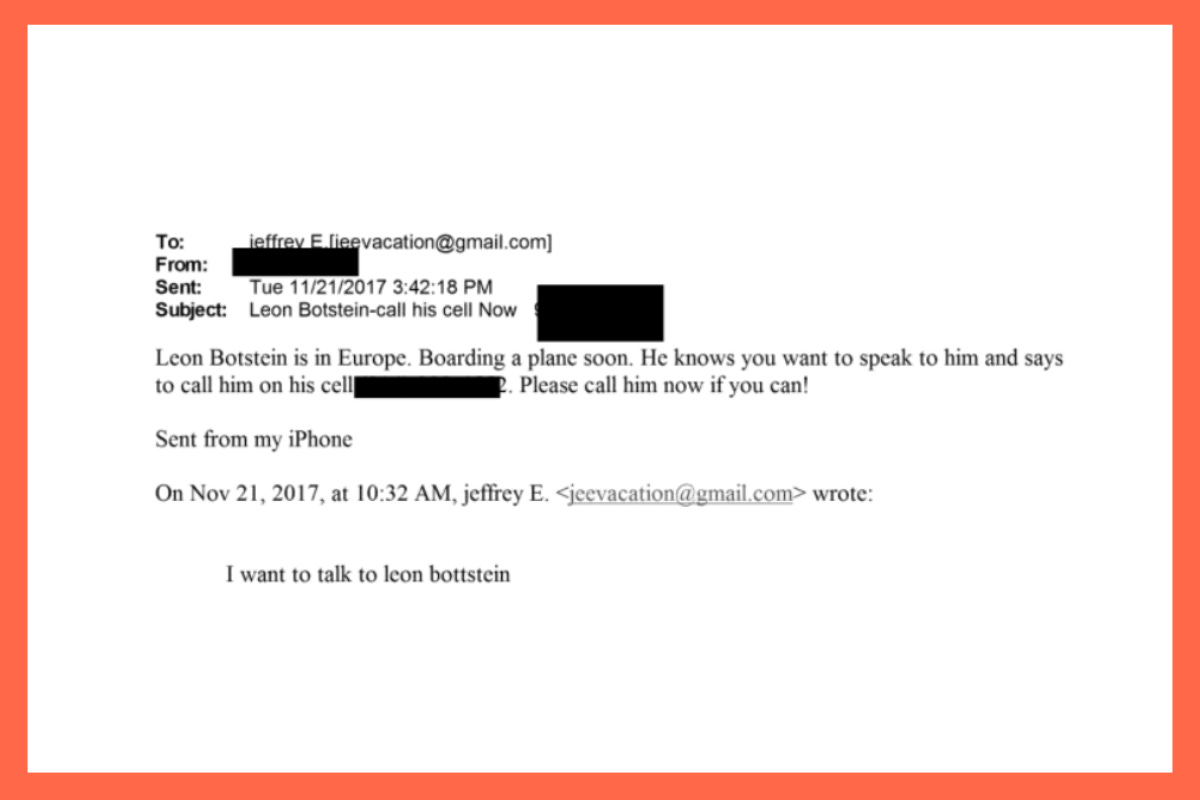
Update (6. February 2026): Further emails relating to Leon Botstein confirm that he did travel to Jeffrey Epstein’s private island in December 2012. Additional context about this trip is covered by Vimal Patel in the New York Times.
Update (5. May 2026): In an email sent to Bard alumni last week, Leon Botstein announced that he will retire as president of the college effective next month. He will continue to serve on the faculty work with SummerScape, the Bard Music Festival, and the Bard Conservatory, and will also continue to live on campus.
“I don’t know what’s more unforgivable: that conductor and long-serving Bard president Leon Botstein accepted money from Jeffrey Epstein, or that he put me in the position of agreeing with American conservative outrage-monger Dinesh D’Souza.”
I wrote those words in 2023 for VAN Magazine, shortly after news broke about Botstein’s meetings with Epstein after the financier and convicted sex offender’s first stint in jail for having sex with a minor. The meetings came after Botstein accepted two donations from Epstein for Bard College, where Botstein also oversees the annual Bard Music Festival and SummerScape programming. The donations had been relitigated in the press some years earlier, shortly before Epstein’s death in 2019, but the news of the multiple meetings came out only after a wider report by the Wall Street Journal on Epstein’s datebook.
The Dinesh D’Souza bit was from my own research, quoted in a Times profile on Botstein from 1992: “He is ideologically unpredictable, even eccentric. That’s partly a function of intellectual suppleness and partly a function, I suppose, of incoherence.”
In 2023, that ideological eccentricity and coherence was on display in a Times follow-up that interrogated Botstein’s meetings with Epstein. “People don’t understand what this job is,” Botstein said at the time. You cannot pick and choose, because among the very rich is a higher percentage of unpleasant and not very attractive people. Capitalism is a rough system.” A few paragraphs later, Botstein was quoted as saying: “A guy sent us money, and we followed up. It’s a simple story.”
Yet newly-released documents in the Epstein Library seem to further the incoherence. Botstein’s follow-ups cover a period from July 2012 to July 2018 (one year before Epstein’s final arrest). As of this writing, their correspondence is linked to 2,558 documents.

Many of them are the sort of emails you’d expect to see from the head of an organization that relies on donations to a lead they’re trying to cultivate. A string of messages from Botstein to Epstein between 2015 and 2016 request phone calls and in-person meetings or offer invitations to performance at Bard and Carnegie Hall. At times, the back-and-forths with Epstein and Botstein’s assistants seem like a massive dick-swinging contest to see who has the more packed, less yielding schedule. I’m not interested in speculating on the size of Botstein’s right superior parietal lobe (as Robert Lawrence Kuhn once did with Epstein), but I wouldn’t mind having the chance to observe his reactions to Epstein’s culturally capitalistic bloviating.
You can understand why Botstein called his acquaintance with Epstein “a humiliating experience to go back over and over and over” in the 2023 Times piece, adding: “We’re completely at the mercy of the very wealthy.” There’s also the fact that over the course of six years Epstein never seemed to figure out how to spell Botstein’s last name correctly — a last name that is 71% identical to Epstein’s own.
Perhaps even more humiliating is how much Leon Botstein’s previous statements struggle to bear weight with these newly-released documents. In 2023, the Wall Street Journal reported that Epstein had visited Bard in the summer of 2013 to see its production of Sergei Taneyev’s Oresteia, traveling to Annandale-on-Hudson by helicopter with his female assistants.
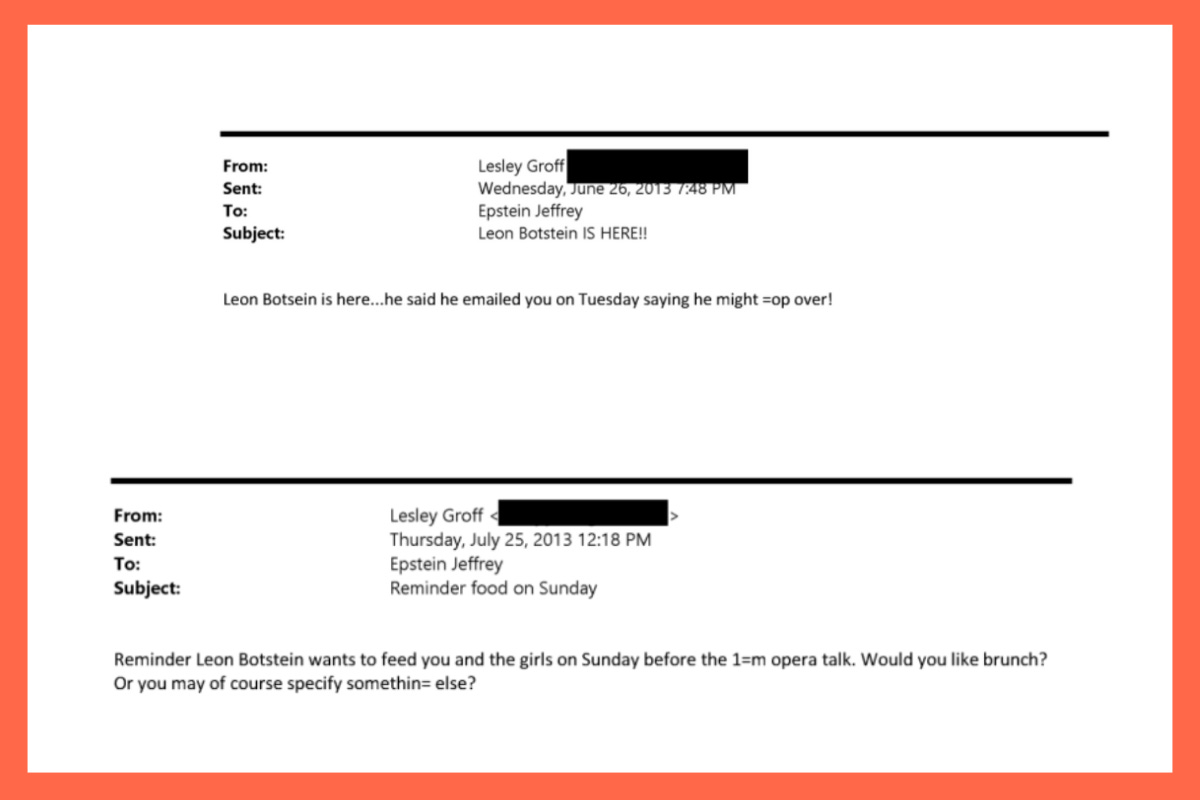
In his subsequent interview with the Times, Botstein said he “never witnessed young female assistants around Mr. Epstein…and that he did not remember whether he had met Mr. Epstein during those visits.” An email sent to Epstein from his assistant, Lesley Groff, dated July 25, 2013, reads: “Reminder Leon Botstein wants to feed you and the girls on Sunday before the 1pm opera talk. Would you like brunch?” That would have aligned with the performance schedule for Oresteia. (You have to wonder what Epstein made of the three-hour work about abuses of power and the transmutation of private crimes into public justice.)
About a week later, Botstein wrote Epstein to invite himself to Zorro Ranch: “How about my getting to Santa Fe on Friday and leaving on Sunday morning?” This visit was seemingly delayed or repeated, according to an email sent from Groff to Epstein on August 8: “Reminder Leon Botstein wanted to go to the ranch Aug 23/24 … did we need to start working on his trip?”
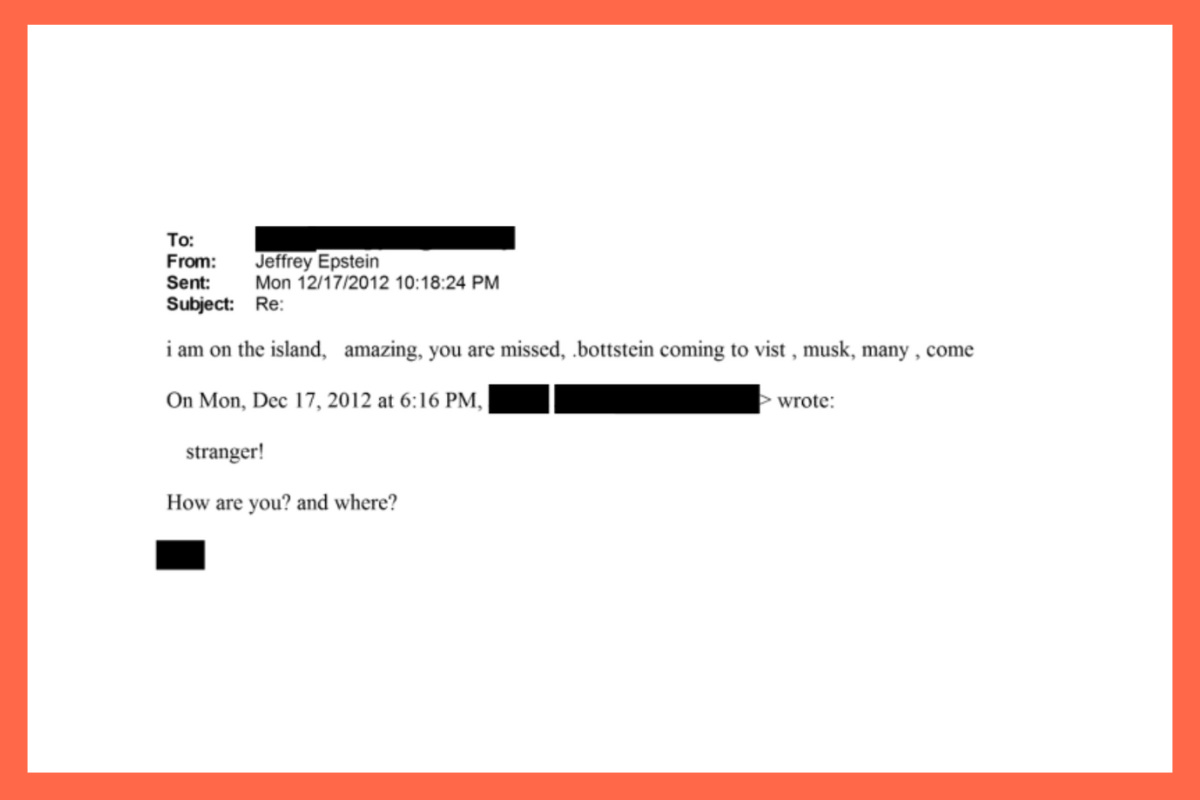
Other documents suggest that Botstein visited Little Saint James, Epstein’s private residence in the Virgin Islands. An email from Groff to Epstein on December 17, 2012 looks at flight options JFK to San Juan, Puerto Rico for Botstein. In another email sent on the same day, Epstein tells an unnamed recipient: “i am on the island, amazing, you are missed, .bottstein [sic] coming to visit, musk, many , come.”
Indeed, for someone who feels humiliated at the prospect of “going back over and over” his ties to Epstein, Botstein seems to have gone back over and over to Epstein himself. His was on a list of names that Epstein suggested for some sort of meeting with Bill Gates — alongside Woody Allen, Ban Ki-moon, the Prime Minister of Qatar, and “Victoria Secret Models” (this last suggestion is followed by a question mark). In 2015, Botstein programmed pianist Simon Ghraichy, whom he describes as a “protegé” of Epstein’s, in the 2015 Bard Music Festival.1 He appears to have met with Epstein and violinist Justina Auškelytė, whom Epstein supported during her studies at Juilliard with both cash and career opportunities.
Botstein also served as a paid consultant to Gratitude America Ltd., a nonprofit that Epstein established in 2012, allegedly as a money and image-laundering operation. (He told the New York Times that he donated the $150,000 consulting fee to Bard.) Epstein declined to renew Botstein’s contract with Gratitude America for 2017, however later that year he purchased a Patek watch that presumably went to Botstein: Emails sent the following year confirm a $10,000 deposit sent from Botstein to Epstein for a watch valued at $51,615, as well as a payment plan that would cover quarterly installments through 2020.
At Bard, Botstein saw second chances as “part of our educational mission,” in his defense of accepting Epstein’s donations. “You wouldn’t criticize a priest for giving communion to a convicted felon.” This may be true, but I don’t know what I would make of a priest accepting a luxury watch from a convicted felon.
There again, there are no priests in this equation. Whether or not Botstein shared Epstein’s beliefs or approved of his behavior is beside the point given the broader context. As I wrote in 2023, Botstein’s history as a college president was tied to his long-articulated views on sex, power, and elite exception, all of which functioned in practice to normalize conditions that Epstein would later exploit (while also creating at Bard an ecosystem of unpleasant money rationalized as intellectual pluralism). In 1990, responding to a group of student protests against allegations of sexual harassment and rape at both Simon’s Rock and Bard, he said: “There is always going to be some libidinal component if we achieve the close teaching and mentoring to which we aspire — particularly using the so-called Socratic method.”2
The following year, he told the New York Times that there should be rules in place to prevent abuses of power, but that regulating or outright banning relationships between students and professors went against the role of colleges to “protect diversity, dissent, and an implicit critique of bourgeois morality.” He also spoke wistfully of the film Chariots of Fire, and its scenes of Oxford professors socializing with their undergraduates over sherry. “That’s against the law today. Not possible. Forbidden. A certain sensibility has driven out conviviality.”
And in 2015, during an “open house” discussion about sexual assault on campus and in between his own visits with Epstein, he told Bard students: “You have to use common sense. A girl drinking a bottle of vodka and then going to a party is as wise as me walking into a Nuremberg Rally while wearing the yellow badge.”
This rhetoric is familiar, sensibility as repression, accountability as bourgeois morality, power as misunderstood virtue. Botstein deployed it against students and critics long before Epstein entered the picture, and by the time he did enter, it was into a system that had a new level of fluency in minimizing power imbalances and defending eccentric exception. One of the arguments often thrown around now is the inability to hold two truths at the same time, and I’ll happily bite: It is true that Botstein told the Wall Street Journal in a 2023 interview that he found Epstein “odd and arrogant.” It is also true that he sent Epstein an email in 2013 thanking him for his “candor and [his] friendship.”
That email came after another failed attempt at fundraising — this time for the American Symphony Orchestra, where Botstein has served as music director since 1991. Epstein had apparently considered donating to the ensemble but, based on Botstein’s response, hesitated over three major concerns: the orchestra’s repertoire, its concert formats, and the generally critical reviews of Botstein as a conductor.
“The truth is that I have been such a thorn of the side of critics, conductors and managers that I am not surprised at what you found,” Botstein writes in response to the third point. “But you will find support and real support within the profession. Pardon the expression but I have not gotten medals and awards for anything but my work in music.3 I just got the Bruckner Medal this month (the other recipients have been Toscanini and Walter, among others). And I got the same Austrian Cross for contributions to music as Sir Simon Rattle--the same year. I hate that stuff, but there it is.”
It’s by far his longest publicly-available email to Epstein, and the least decorous — invoking a Grammy nomination (for a recording made with an entirely different orchestra), suggesting that if, even with a gift from Epstein, “there can be no measured improvement on the execution front” he would take some decisive action about his future with the ASO, and leaning on Wittgenstein for rhetorical support.
“I am not Moses, and if there were a God, he would not be on my side. (Another reason to help),” the email concludes. “I greatly cherish this new friendship and I have real admiration for how you go about doing things — tough as it is often I truly enjoy the argument. But this time I and not your preliminary findings and researchers — am right. Given the firestorm I created 20 years ago I am even surprised I did as well in your research, whatever grade you put on the result. It is not the final exam, only a badly constructed mid-term, I am a bit proud not to have gotten a top grade. True controversy rarely leads to praise in this business. Nabokov became famous and admired only at the end.”
Despite even this seemingly pointed reference to the author of Lolita, Epstein is unmoved and his reply is curt yet oblique:
“When treasures are ‘rediscovered’ (not sure the ‘re’ is appropriate), it needs to be evaluated (here you can use ‘re’). It requires close examination to ascertain its new value. The auction house is a nice way of [determining] it, and a long way on its path to recognition.”4
Botstein concedes some of this point, but argues against the metaphor of the auction house, adding that “treasures are not the only purpose of the endeavor.” Epstein is even more direct in his follow-up: “There is a reason you are still struggling and it is not your talent.”
“I have the sense of fighting my worst enemies in a a [sic] shadow way, not openly, and I surely have them. I am not struggling — I am struggling for the primary source of survival in music history for large ensembles — patronage,” Botstein writes back. “And you once asked a question of me. The answer is that I wish to work on the podium, to perform and [to] continue to fight — if one [does] not work one dies inside.”
This type of donor-groveling isn’t new for anyone who has had the burden of fundraising on their job description, and Epstein certainly isn’t the first semi-interested donor who would prefer to see the performing arts treated as a for-profit endeavor. But the exchange takes on a new light given the senders involved and what came next. Botstein stuck it out with Epstein for another five years, even after he denied not his talent, but his inherent value. The equal footing between two men in power loses its balance after reading this, and while I’m not inclined to give Botstein any pity in exchange for his humiliation narrative, I do wonder about his own sense of self-worth — and what happened to his final watch repayments after the summer of 2019.
The third act of Taneyev’s Oresteia is based on The Libation Bearers, and opens with Orestes — having killed his mother in revenge for her having killed his father — hounded by the Furies. “They follow me everywhere like shadows, hounding my steps, malevolent threats oozing from their lips like pus,” Orestes sings. “I’m at the ends of the earth but there’s nowhere to hide.” In a lecture on the work, recorded in 2020, Botstein describes these Furies as representative of a “raw justice”; the idea that Orestes must die for killing his mother. By the finale, Botstein adds, this raw justice will lose to more a reasoned, deliberate justice as embodied onstage by Athena.
“The cycle of violence in human society has to come to an end,” he explains. “The restraint of the desire for revenge through violence is a rite of passage from a society that’s based on violence to a society that’s based on the rule of law.” Yet that argument assumes a clean break between violence and the law. Epstein’s world depended on the opposite: Violence could persist, so long as it learned to speak calmly.
Related


The following year, Ghraichy signed an exclusive recording deal with Deutsche Grammophon, telling the Huffington Post: “It feels so good to be surrounded by professionals from the most prestigious music industry. And yet, they’re all young and bright and sexy!”
“Socratic method.” Update: This video appears to have been made private, but the clip showed author Gary Shteyngart saying “This is Socratic method” in an overtly Slavic accent while making a jerking-off motion.
He’s actually received many awards for his work outside of music, and many of his awards within the profession are more for his research than his performances.
Email edited slightly for clarity and grammar.
This is brilliant - thank you for writing so insightfully and powerfully about the Epstein files and the conceptual & actual links to classical music and musicians.
I saw an email yesterday quoted on Bluesky where Botstein makes some self-deprecating remark about preparing for a Carnegie Hall concert (in 2014) and “putting homeless people to sleep again,” and I almost felt sorry for the poor groveling bastard, but that’s the life he chose, so.