
There’s a line from an Elif Batuman interview that ran during my time at Time Out New York that has stuck with me for the last 15 years. Discussing Dostoevsky with Parul Sehgal, Batuman says the Russian author’s work is “not meant to be realistic — you know, like Oedipus Rex isn’t about killing your father and sleeping with your mother — it’s a play that depicts certain universal dramas and tensions through the bizarre and hyperbolic example of a king who kills his father and sleeps with his mother.”
Oedipus Rex isn’t realistic, but it also shows us the shortcomings of what happens when we trust illusions over reality. The Greek god of the theatre, Dionysus, is also, as E. R. Dodds put it, “the god of illusion.” What is real in Oedipus — the fact of the title character’s parentage — remains elusive (illusive?) to him until the fateful reveal. In response, he gouges his eyes out and begs for exile, “far from sight.” In this way, Aristotle would later argue, Sophocles’s play is the perfect tragedy, combining a flawed hero, a gut-punch of a recognition and reversal, and the catharsis that comes from seeing the ancient car wreck play out in real time. If it’s not realistic, it’s at least real. Centuries later, in Renaissance Florence, Vincenzo Galilei would also cite catharsis as a key goal for a new form of musical drama that would later become known as opera. Music was, like tragedy, a purifying source that could stoke “virtue among those who were born to achieve and perfect human bliss — in other words, the purpose of the state.” One wonders what Vincenzo Galilei (or Dostoevsky, for that matter) would have to say about the current state of the Kennedy Center.
I thought of the cathartic realism of Oedipus Rex once again last month while reading an essay titled “The Death of the Author’s Decency.” In it, writer R. Wang contrasts the politics of essayist Jia Tolentino and novelist Sally Rooney, painting them as a sort of Goofus and Gallant for a literary culture that vociferously rewards political fluency while quietly disincentivizing actual political risk. Although Rooney and Tolentino have both spoken out on the genocide in Gaza, Rooney has backed up that speech with material support for the organization Palestine Action (following the group’s highly-contested proscription in the United Kingdom). Tolentino, after writing about bringing her children to protests for Gaza in a New Yorker essay, announced a partnership with Airbnb Experiences — a contradiction both to Tolentino’s years of criticizing capitalism and influencer culture and to the specific political situation in Palestine.1 Tolentino quietly deleted her Instagram post announcing this partnership, but her Airbnb Experience (a shopping trip at McNally Jackson Books followed by the chance to have drinks and “gossip with the cultural force”) is still listed on the site.
In her same essay for the New Yorker, Tolentino writes that, in our age of anxiety, “it’s easier to retreat from the concept of reality than to acknowledge that the things in the news are real.… The words blur and the images blur and a permission structure is erected for us to detach from reality — first for a moment, then a day, a week, an election season, maybe a lifetime.” This impulse (which Tolentino is aware enough to label “craven”) is, as Wang points out, in the same zip code as what my colleague Neil Fisher describes as “the messy intersection of culture and politics.
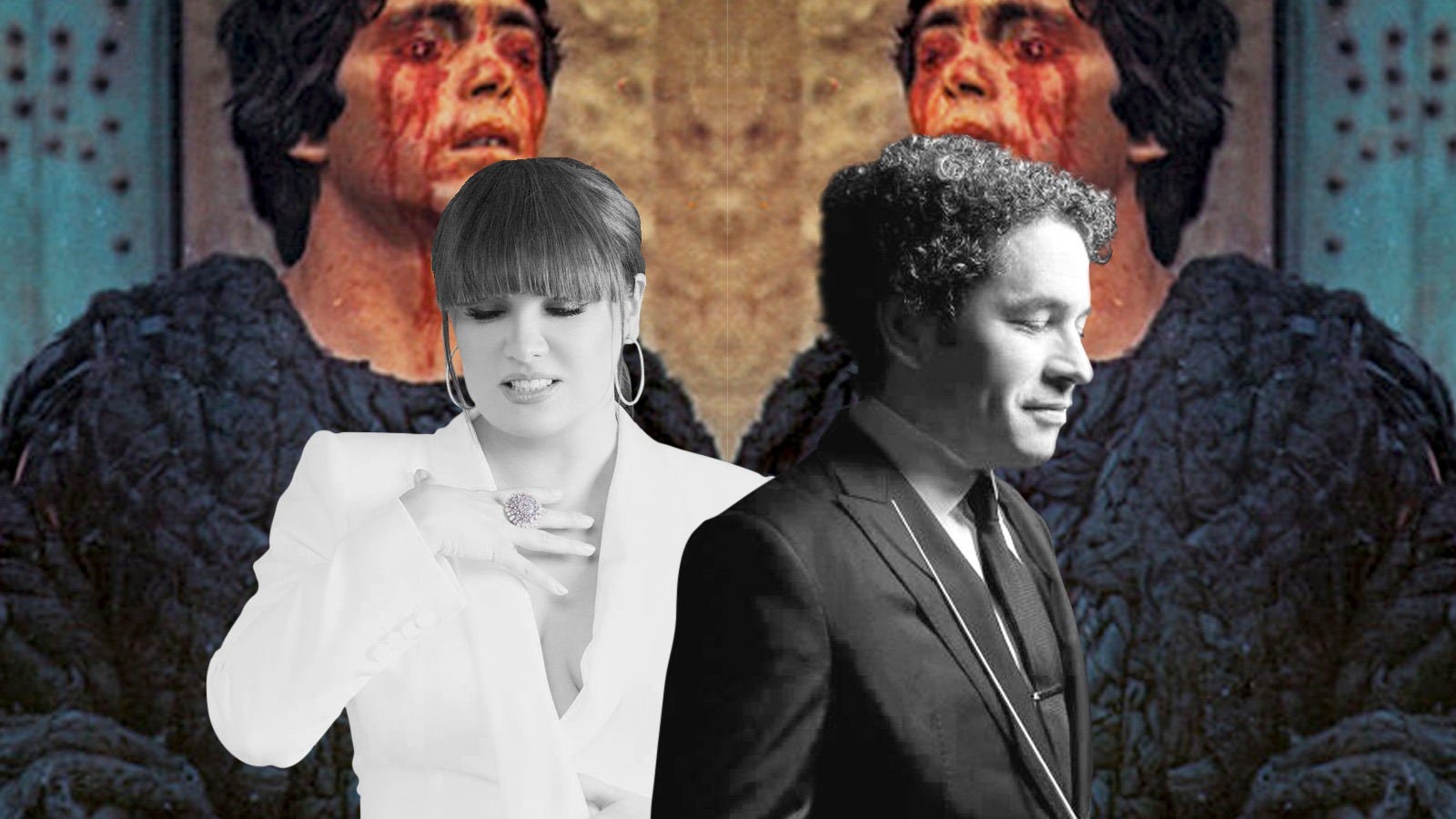
“Artists have been castigated for jumping on bandwagons,” Fisher continues in a video short for The Times. “But also sometimes attacked for not speaking out on hot-button issues.” I saw the post, which accompanied Fisher’s review of Anna Netrebko in Turandot at the Royal Opera, just a few hours after reading Wang’s essay and couldn’t shake the latter’s framework.
Netrebko is not one to jump on bandwagons. In 2022, she was seemingly dragged, kicking and screaming, into the discourse surrounding Russia’s full-scale invasion of Ukraine. Her initial statement attempted to bothsides its way out of controversy, and came with a coda: “Forcing artists, or any public figure, to voice their political opinions in public and to denounce their homeland is not right,” Netrebko said. “This should be a free choice. Like many of my colleagues, I am not a political person. I am not an expert in politics. I am an artist and my purpose is to unite people across political divides.” (The same statement was copied, word-for-word, by her then-husband, tenor Yusif Eyvazov.)
When Netrebko eventually and expressly condemned the invasion, it was for many too little and too late. It was also hard to reconcile even a conclusive anti-war post with Netrebko’s robust internet archive of posts, former interviews, and images that included comments in support of Putin and a photo-op with pro-Russian separatists in Donetsk. I don’t envy Fisher having to give a line read of her 2011 comment about Putin’s “strong male energy.” While Netrebko has begun to make returns to high-profile houses that initially paused their working relationships with her, her performances are still met with small but dedicated protests — including her earlier return to Covent Garden this season as Puccini’s Tosca.
I agree with Fisher that Netrebko’s glamor and high profile make her “a useful target for those wanting to marginalize Russia’s cultural impact on the world,” even if she is not the most culpable artist. Her statement may not undo years of support for Putin, but it was still more than many other Russian musicians have done — and earned her attacks in the Russian media. Unlike many of her colleagues, Netrebko has also not returned to Russia since the escalation of the war. Others, including non-Russian nationals, have continued to perform in the country at venues and festivals that receive government funds and are often invoked in the not-so-soft power of cultural supremacy. Bass Ildar Abdrazakov is now head of the Sevastopol State Opera and Ballet Theatre in occupied Crimea.2
In theory, I would also like to agree with Fisher when he concludes: “I go to the opera to enjoy great musicians. It would be a bonus if they were fine, upstanding citizens, but I’d rather listen to campaigning slogans from politicians.” It is the nature of our current reality, however, that rejects easy compartmentalization. “I still consider Tolentino a fantastic writer,” Wang writes. “But when it turns out you’ve…accepted a sponcon from a company with views contradictory to what you’ve previously claimed, I’m going to feel angry, to feel like these writers are predatorial and hypocrites. And it has nothing to do with the quality of their work.”
That anger is real and righteous for audiences, for whom going to a live performance can be as vulnerable an experience as it is for the performer. In some ways, reality is more distorted now than it has ever been thanks to the swift advance of generative-AI, a media cycle that runs on rage, and the trickle-down effects of leaders who treat truth as a strategic variable rather than a shared obligation. Whether we go to see a live performance as a respite from reality or a response to it, we can’t Eternal Sunshine of the Spotless Mind ourselves out of knowing where many artists now stand in relation to the rest of the world.
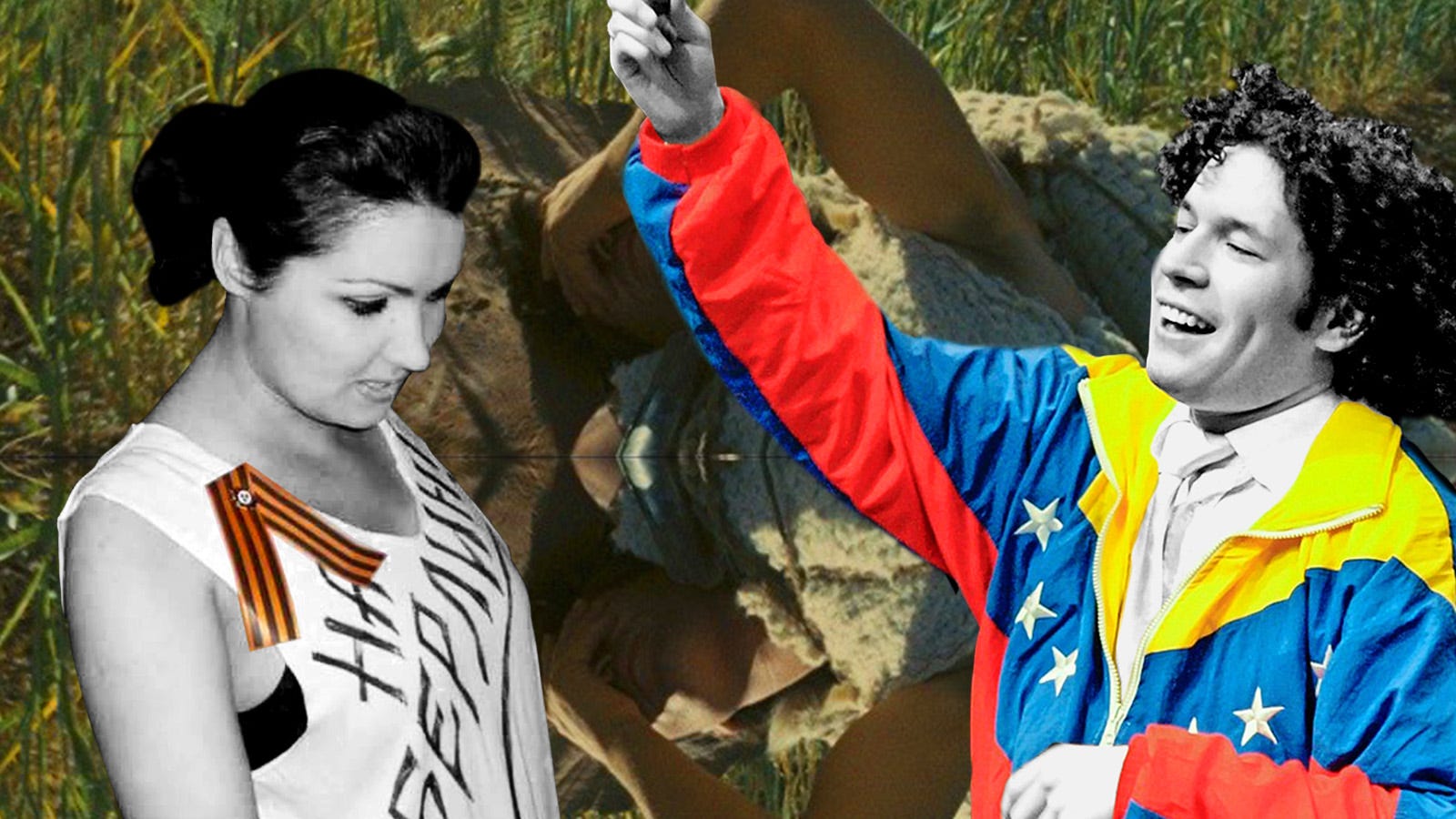
It’s not that they owe us campaigning slogans. In fact, many of them are already doing that to excess. “I am neither a politician nor an activist,” wrote Venezuelan conductor Gustavo Dudamel in a 2015 op-ed for the Los Angeles Times. “Although I am aware that even something as benign as conducting an orchestra may have deep political ramifications, I will not publicly take a political position or align myself with one point of view or one party in Venezuela or in the United States.”
At the time, amid growing unrest in Venezuela, many had become critical of Dudamel for his silence on Nicolás Maduro, a significant sponsor for El Sistema and the Simón Bolivar Symphony Orchestra. Two years later, an El Sistema violist was among those killed by Maduro’s troops at a demonstration in Caracas. Another violinist had his instrument broken by the National Guard and was subsequently arrested and tortured. If you aren’t interested in politics, it’s far more likely to become interested in you. Dudamel spoke out against the violent repression of civic life in his home country, and hasn’t been back since. Yet, as he indicated to The Telegraph last year, he still hasn’t fully absorbed that lesson: “Everything is over-politicized in the world right now. I believe we can only do the right thing with the tools we have and the tool that I have is music.”
I don’t expect Dudamel or Netrebko to become politicians any more than I expect there to be an actual King of Thebes who killed his father and slept with his mother. But as Wang points out, “the reality holds true that greater access to institutional power means you possess more responsibility to resist derealization.” To be two of the most famous classical musicians working today and saying you “only” have music and art is a form of moral gerrymandering, a compartmentalization that ignores the fact of your profile and platform. In Sophocles, pleading detachment is the first step towards an inevitable recognition and reversal. Eventually, even Oedipus had to look.
Among its many ethical issues, Airbnb allows for listings of properties in the West Bank by Israeli nationals whose occupation of said land represents a violation of international humanitarian law.
Yusif Eyvazov, a native of Azerbaijan, was likewise appointed director of the country’s State Academic Opera and Ballet Theater. He also praised the ethnic cleansing of Nagorno-Karabakh, and previously refused to sing in a gala concert alongside an Armenian soprano.
Previously on “art isn’t political”
Music Unties

Ildar Abdrazakov, Aigul Akhmetshina, Anna Geniushene, and artists who continue insist that art has nothing to do with politics.
Can We Please Stop Pretending that Music Is Going to Lift Us Above Anything, Let Alone the Current Global Political Landscape?

Or, why the hell is Lawrence Brownlee singing in Moscow?

Thanks for this post, as well as all your posts interrogating the public face of the elite. I wonder if a closer look at the financial operations of classical industry would bear fruit. How much does Dudamel make? What is Netrebko's fee? How big is the disparity between headliners and second-string soloists, not to mention first violin? Who actually holds the purse strings? I'm a jazz cat first, classical music is my second language, but from where I sit, it seems like the whole world of grand opera and the state-sponsored symphony is essentially "the rich at play." (Joseph Kerman in CONCERTO CONVERSATIONS (I'm paraphrasing): "Opera is one of the few places left where the rich can display their clothes and pearls in front of each other.") I am going to Yuja Wang and Thomas Adès at the end of the month in NYC, and the cheapest pair of tix total $500. I'm paying it, but it is really a stretch.
Reading endless apologetics and getting lectured about how "we have to separate the art from the artist" or how we have to "keep politics out of it" is one of the surest ways to get me yelling. All I can think about is Hanna Gadsby's incandescent rant about Picasso and how if you really believe you can separate him from his art, just take his name off one of his paintings and see how much it fetches at auction. All I can think about is somebody pointing out a decade ago how quickly all these apologists run to defend the reputation of yet another monster, rather than the well-being of the lesser-known artists they abuse. I remember a journalist telling me (in workshop at Darmstadt) that we just *couldn't* subject some asshole conductor to any real accountability, despite a lifetime of him acting like a monster, because "his Debussy recordings are incomparable."
Great. Now I'm feeling stabby again.