

Margarethe Arndt-Ober: What Happened During World War II?
A coda on casting in the time of conflict
This post originally ran as a subscriber bonus linked to the post Force Majeure’d: The Story of Margarethe Arndt-Ober.
In Friday’s edition of Undone, I took a look at the life and career of German mezzo-soprano Margarethe Arndt-Ober. If the available recordings of Ober (who used her maiden name onstage), combined with the press she garnered following her US debut, are any indication, she may have become the Anna Netrebko or Elīna Garanča of her time. But the US involvement in World War I furloughed Ober from the Metropolitan Opera stage beginning in 1917.

Her subsequent lawsuit against the Met didn’t engender support for her to return to the company following the end of the War. Of course, hindsight being 20/20, it’s hard to comprehend what would have happened to Ober and many of her fellow colleagues — including Melanie Kurt, Johannes Sembach, Carl Braun, and Hermann Weil — who were sidelined due to anti-German sentiment and a sentiment described at the time as “America First.”
Carl Braun joined with Ober and baritone Otto Goritz in the failed 1919 German opera company project, and never sang at the Met following the 1916-17 season. In fact, Goritz had opted to resign from the company, along with soprano Johanna Gadski, after news broke that he had sung a “virulently anti-American” song about the sinking of the Lusitania at her New Year’s Eve party in 1915. It took the Met another two seasons to reinstate German-language repertoire (the protests at the opening of the 1919 company formed by Ober, Braun, and Goritz showed that, even a year after the Armistice, it was too soon).
On the other hand, patience paid off for Johannes Sembach, who returned to the Met stage beginning in the 1920-21 season, headlining Tristan und Isolde. He was the only one of his colleagues to make a comeback (even substituting for an indisposed Caruso), singing for two more seasons before returning to Germany.
But Ober became a cautionary tale for singers who would be affected by the next World War just 25 years later. The Met during World War I was still fresh in memory as the US eventually entered World War II, two years after Germany invaded Poland. An August 1941 issue of Variety detailed the challenges that singers would once again face, both in getting around from one engagement to the next (easier thanks to airline travel but still dangerous during a war), and in getting work at all depending on their country of origin.
“Should war break out,” Variety cautioned, “Licia Albanese and Stella Roman, Italian and Roumanian sopranos of the Met, might run into the same trouble as overtook Johanna Gadski, Margarete Ober, and Karl Muck in World War No. 1.”
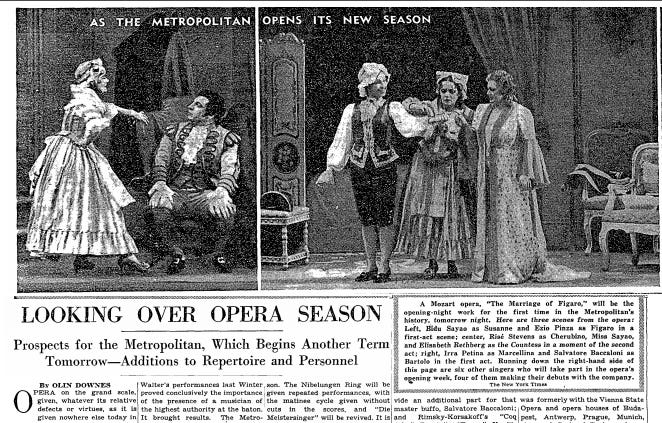
The Met’s 1941-42 season opened with Le nozze di Figaro on November 24, and in its first few weeks had a lineup that included Der Rosenkavalier, L’Elisir d’Amore, La Traviata, Tannhäuser, and Madama Butterfly. Previewing the season for the New York Times, Olin Downes noted that “Opera is presented [at the Met], as a prevailing rule, in the language to which it was compose, and with casts accustomed to sing the composer’s language. We are of those who prefer opera that way… Even today, with the world at war […].”
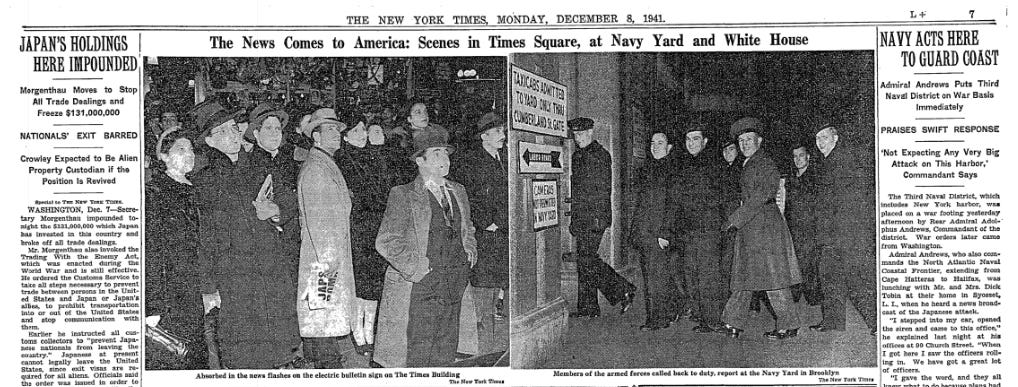
Despite past precedent and the warnings of Variety, however, singers like Albanese (who became a US citizen in 1945), German soprano Lotte Lehmann, and Italian bass Ezio Pinza remained on the Met’s roster. So, too, did German and Italian-language works. While the conflict still rendered it impossible for many European-based singers to travel, General Manager Edward Johnson seemed to take the approach that Gatti-Cassaza had tried to espouse: the opera house as neutral territory.
Yet, the US also enacted harsher measures against “enemy aliens” — placing many German and Italian immigrants in internment camps as they famously did with Japanese nationals and Japanese-American citizens. Two days after singing Colline in La Bohème with the Met in Philadelphia, Pinza (who was weeks away from becoming a US citizen) was arrested and detained for three months on Ellis Island on charges that were never clearly articulated by the government. (The entirety of Pinza’s ordeal is worth a deep dive in and of itself.)
But this inclusiveness doesn’t tell the whole story. For the US, Japan was the major adversary in World War II, not Italy or Germany. Japan was the country to drag the US into the conflict as the first of the Axis Powers to launch an attack on American soil. And the Met’s roster in the 1940s, while inclusive of European artists, was still uniformly white. The company’s first African-American singer would be Marian Anderson (who only in 1939 had given the famous Lincoln Memorial concert) in 1955.
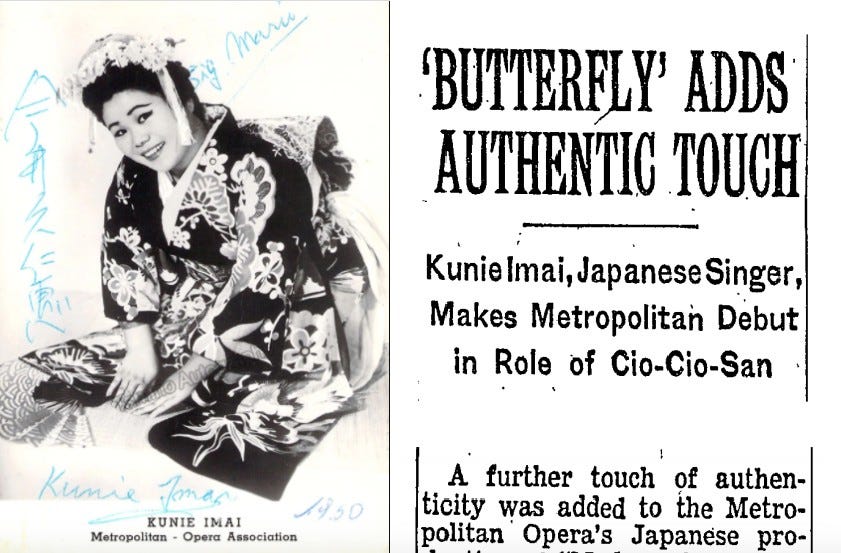
The first Japanese singer to sing onstage at the Met, Kunie Imai, made her debut — and only performance — in 1958 in Madama Butterfly. Six years earlier, Tomiko Kamazawa made a first by performing with the company on tour. (Sidebar: Unlike Marian Anderson’s story, this first for the Met takes some digging, perhaps due in part to the fact that the casting of Asian singers in roles other than Madama Butterfly or Turandot didn’t really take off until the late 1980s.)
This preexisting imbalance made it easy for the Met to avoid a casting decision that could have resulted in another Margarethe Arndt-Ober. Although one work was dropped from the repertoire until 1946: Puccini’s Madama Butterfly.
