

The Unquestioned Answers
When Wisława Szymborska reviewed the Three Tenors
This piece originally ran as a subscriber bonus to the final installment of Six Degrees of Plácido Domingo.
As I wrote last week, before news of the Clinton-Lewinsky Scandal broke in January 1998, The Private Lives of the Three Tenors (published in December 1996) received very little press attention. This lukewarm reception came in spite of a healthy amount of coverage of the Three Tenors themselves at this time. Still, one of the few reviews that survive of Marcia Lewis’s The Private Lives of the Three Tenors carries an unlikely byline: poet and Nobel Laureate Wisława Szymborska.
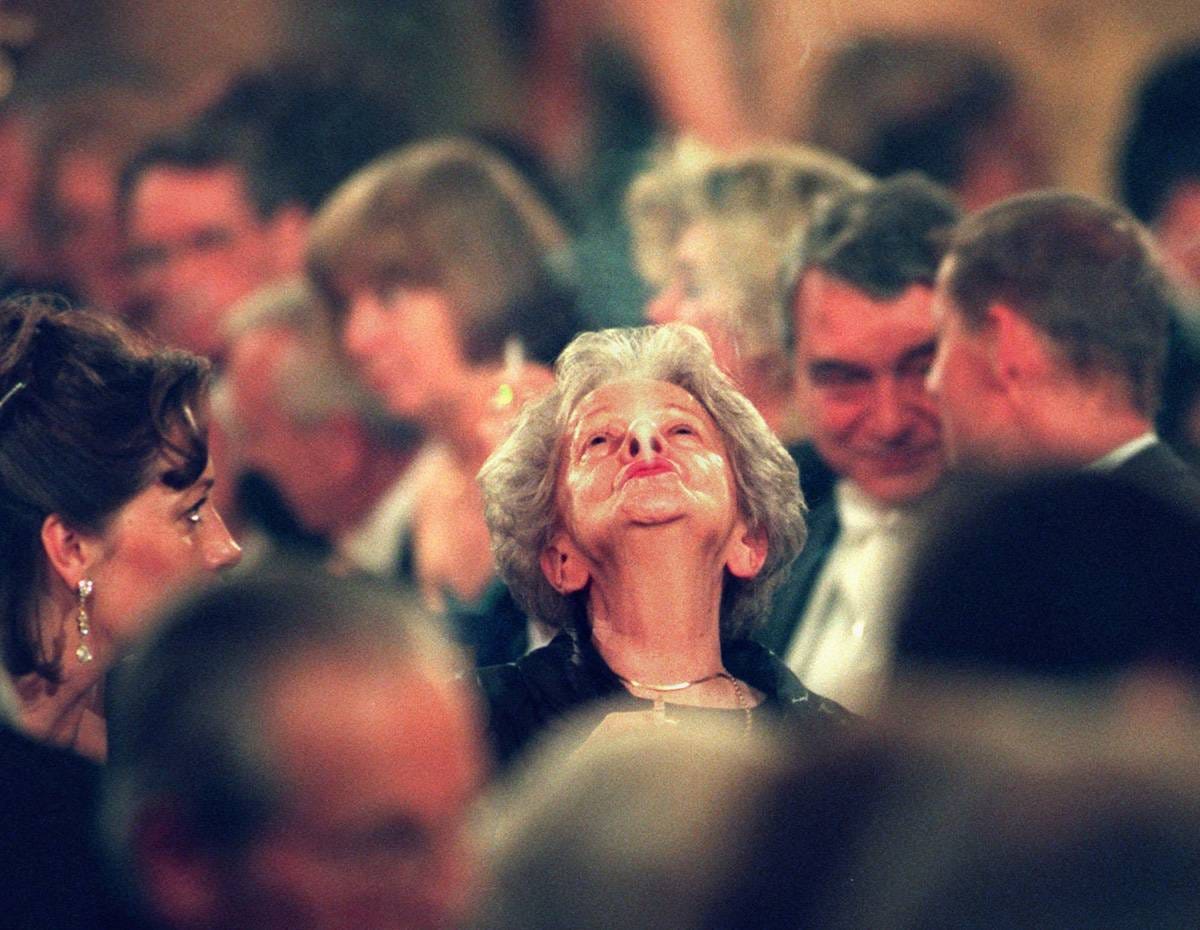
Szymborska’s review, titled “The Nut and the Gilded Shell,” ran with the book’s translation into Polish in 1999 under Szymborska’s long-running column in Poland, “Nonrequired Reading,” which in turn was dedicated to not the books that accumulated accolades and newsprint, but those that were popular hits despite literary laurels. This is how Lewis’s book merited its own Szymborska review. “Even the worst book can give us something to think about.”
Aptly enough, Szymborska won the Nobel Prize in Literature the same year that The Private Lives of the Three Tenors was originally published. In her Nobel Lecture, she remarked that the “droves” of biopics about great scientists and artists are no accident:
“The more ambitious directors seek to reproduce convincingly the creative process that led to important scientific discoveries or to the emergence of masterpieces,” she said, adding later that “Of course this is all quite naive and doesn’t explain the strange mental state popularly known as ‘inspiration,’ but at least there’s something to look at and to listen to.”
Lewis’s Private Lives reads at times like its own biopic, written with the gratuitous montages, close-ups, and trailer voice-overs. Her time in and covering Hollywood shines through in the pitch that the personal histories of Domingo, Pavarotti, and Carreras “surpass even those of their larger-than-life characters on the opera stage,” presenting an “unvarnished story” of “grand indulgence.” In her introduction to “Domingo as Don Juan,” Lewis talks about the inspiration that Lorenzo Da Ponte sought while writing Don Giovanni, writing that the librettist would sequester himself with a bottle of Tokay, an inkstand, and a box of Seville tobacco to keep the inspiration flowing. When those methods failed, he would ring the bell for his maid — or, rather, his maid's sixteen-year-old daughter.
“She came into my room whenever I rang the bell,” Lewis quotes from Da Ponte's memoirs, “which in truth was fairly often, and particularly when my inspiration seemed to cool.” Lewis adds in her own narrative, doubling the entendre: “Sometimes she brought him a biscuit. Sometimes a cup of coffee. And much more.”
Lewis also recounts a legend from the staging of Don Giovanni, tying together inspiration and power: Mozart, unhappy with the scream that the singer playing Zerlina was making at the end of Act I, decided to elicit the proper scream by sneaking up behind her and groping her at just the right moment. “Then,” Lewis writes (emphasis her own) “she screamed perfectly, to the complete satisfaction of the composers. Such was the power of the seductive Don Juan.”
I wonder, then, how Szymborska read The Private Lives, and whether or not she went in with the expectation that it would, in its own way, try to do justice to the inspirations that drove all three men. Either way, something about Lewis’s book failed her expectations.
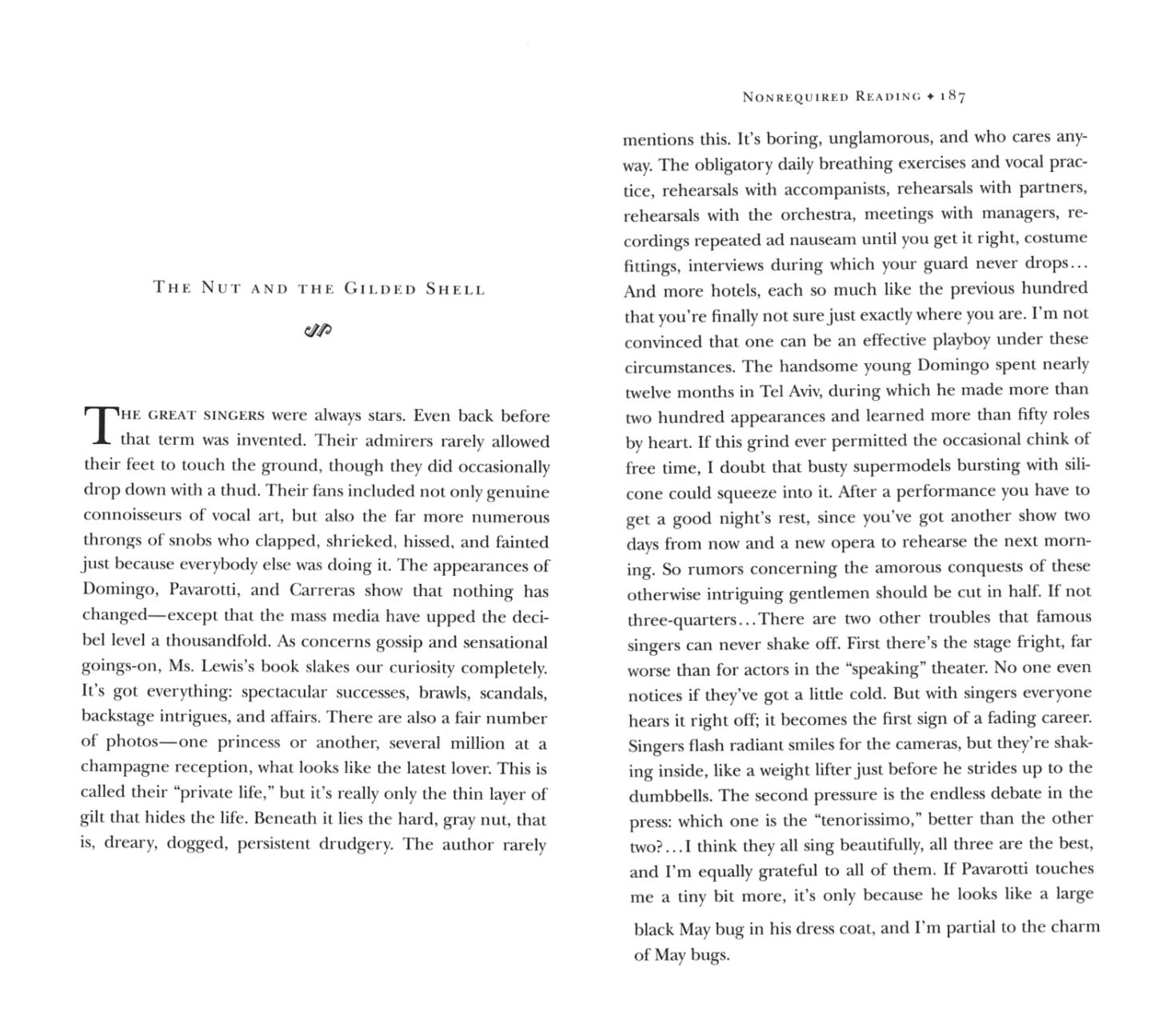
“As concerns gossip and sensational goings-on, Ms. Lewis’s book slakes our curiosity completely,” Szymborska concedes. “It’s got everything: spectacular successes, brawls, scandals, backstage intrigues, and affairs. There are also a fair number of photos—one princess or another, several million at a champagne reception, what looks like the latest lover.
“This is called their ‘private life,’” Szymborska continues, “but it’s really only the thin layer of gilt that hides the life. Beneath it lies the hard, gray nut, that is, dreary, dogged, persistent drudgery. The author rarely mentions this.”
It’s a fair criticism, especially in a time before social media gave us a deeper look into the dreary, dogged, persistent drudgery. But I think the metaphor of sex as gilt may also be ill-fitting here. When Szymborska, revisiting Domingo’s year in Tel Aviv, suggests that if the grind of learning 50 new roles “ever permitted the occasional chink of free time, I doubt that busty supermodels bursting with silicone could slither into it.”
Perhaps this is true. But, as we’re learning with more and more reporting on #MeToo, the abuse of power and sexual misconduct that comes with the territory very quickly become part of the routine versus an exciting perk. Despite the thrill of intrigue that comes with opera plots that involve sexual bargaining (Il trovatore’s Di Luna/Leonora duet in Act IV immediately comes to mind), in real life, as we’ve seen from Jocelyn Gecker’s original AP report, the reality is much more banal. This is the drudgery of evil.
Szymborska died in 2012, shortly before the current #MeToo movement gained steam. But I wonder what she would have made of the current landscape. In her Nobel Lecture, she moves on from inspiration and process to talk about knowledge, noting that “knowledge that doesn’t lead to new questions quickly dies out. It fails to maintain the temperature required for sustaining life. In the most extreme cases, well known from ancient and modern history, it even poses a lethal threat to society.”
If the forms of power that are currently enabling abuses thereof are going to be properly challenged — in classical music and beyond — the knowledge that’s now being codified in our time needs to bring with it new questions. It’s an essential component of the discussion.