
Salomes I Have Known
Burning it all down with the flames of faith.
One of the parts I love most about hosting an opera podcast is diving into the historical context of a work’s premiere.1 At a certain point, with a really good opera in a really good year, it starts to feel like a line from comedian Charlie Bardey: “Sometimes I don’t feel like writing because everything is connected and I can’t get into all that right now.”
That felt especially true for 1905, the year that not only saw the premiere of Richard Strauss’s Salome but also the First Russian Revolution, the founding of the City of Las Vegas, Mata Hari’s debut in Paris, James Hazen Hyde’s “greatest ball of the Gilded Age,” and a vaudeville number called “The Whole Damn Family.” If at some point I am ever faced with the task of explaining Salome using only contemporary cultural references, I’m set.

In this week’s episode of Decanonized (link to listen above), I talk about Salome with Perri DiChristina, better known by many as one half of Thrilled to Announce—a duo I’ve come to think of as the philosophical Fug Girls of opera, and one it now feels impossible we ever did without. Because Salome is never a complete discussion, I was speaking at 1.5x speed in normal time on our call. This led to some of the facts tripping over themselves in my brain in an effort to keep up, and I was in error when I said that I wasn’t sure that Edward Said had ever written specifically about Salome. He had, in fact, described the “shattering musical effect” of both Salome and Elektra, and has a lovely passage about his first interaction with the former:
“I discovered a recording of ‘Salomes Tanz’…and later that year, on a foggy late August afternoon while spending yet another dreary summer in a lonely Lebanese mountain village, I heard the BBC announcement of [Strauss’s] death with an enjoyably mournful regret that I can still capture.”
Okay, it’s not a full deconstruction of the opera, but it’s one that led me to think more about the idea that Perri and I did discuss in this week’s episode: that Salome is more about the decapitation of an empire than it is about the decapitation of John the Baptist.
I must have had some inkling of this in college. As I note on the podcast, I had my first experience with Strauss’s Salome while concurrently working on a design concept for Oscar Wilde’s source text, the semester-long project for a production design class I was taking as a freshman at Fordham. I still remember many of the concepts presented in the final weeks of that semester: one was a seedy hotel in Vegas. Another was at a Fourth of July barbecue in a Far From Heaven-esque world of 1950s suburban conformity. Despite the two professors leading the class cautioning us at the beginning of the project that they had seen enough prison-set Salomes to last a lifetime, one of my classmates made a play for that.
I also had a strong memory of our class of theater majors reading the play out loud at the beginning of the semester, including Kelley Curran as a delightfully throaty Herodias. How apt, all things considered, that my own production idea placed Wilde’s drama in a Gilded Age Newport Mansion (an idea borne out of my growing up in Rhode Island and serving as the flower girl in my mother’s second wedding at Astors’ Beechwood).
How apt that the second season of The Gilded Age culminates in the opening of the Metropolitan Opera with regards to Salome in particular. Oscar Wilde has a cameo in the season. J. P. Morgan, who was responsible for a nearly 30-year ban on the opera at the Met, gets a slightly more significant arc. And George Russell, a template for real-life Met cofounder Cornelius Vanderbilt, is played by Morgan Spector, whose real-life mother-in-law is one of the defining Salomes in the work’s history: Maria Ewing.
By many accounts, the Gilded Age ended by the turn of the 20th Century, with the rise of labor unions and the progressive presidency of Teddy Roosevelt. Even if it had already given up the ghost, it was at least resurrected for James Hazen Hyde’s 1905 ball, which transformed a Fifth Avenue society restaurant into the gardens of Versailles for some 600 guests.
The handsome heir to the Equitable Life Insurance Company, Hyde was destined to become its president when he turned 30 in 1906, but the decadence of his blow-out party was enough to turn Equitable’s board against him. Amid never-substantiated allegations of using company funds to bankroll his $7.1 million party, Hyde resigned from Equitable and spent the next 36 years in France. Salome’s premiere 10 months later could well be seen as the final nail in the coffin of the Gilded Age.
This dovetails with Alex Ross’s description of a 1906 performance of Salome in Graz, conducted by Strauss himself. It’s the set-piece that opens The Rest Is Noise: Listening to the Twentieth Century, and in the attendees alone we see a microcosm of the century to come: Puccini, Gustav and Alma Mahler, Alban Berg, Arnold Schoenberg, the fictional Adrian Leverkühn from Thomas Mann’s Doctor Faustus, and, allegedly, a teenaged Hitler.
The Rest Is Noise sets up Salome as the inciting event that lays out the musical development of the remaining 95 years of the Twentieth Century. As Ross later writes in 2019, “When the clarinet slithers up a disjointed scale at the outset of the piece, the curtain effectively goes up on twentieth-century music.” But I would argue that Salome is also a precursor to the Twentieth Century on the whole. It’s the same dreadful premonition that permeates through the opera’s characters, beginning with Herodias’s Page (who warns Narraboth that “terrible things can happen” if he continues to stare at Salome) and ending with Herod (who nearly sings the same phrase, with critical shift: “terrible things will happen”).
For the Page, this prophecy plays out: Narraboth kills himself as Salome lusts after Jochanaan (a suicide that barely registers with the other characters, save the Page). Onstage, we don’t see whether Herod is also right, but we do know that, nine years after John the Baptist was beheaded, he would lose his kingdom and his wealth after being accused of a conspiracy against Caligula. He died, in exile and infamy, and is generally regarded as one of history’s great tyrants, having both John the Baptist and Jesus’s blood on his hands.
In that same 2019 essay, Ross adds: “Whether Salome lives or dies, she has shattered her stepfather’s corrupt and hypocritical regime. As an angel of destruction, she is worthy of respect.”
When has there not been a period in history without a corrupt and hypocritical regime?
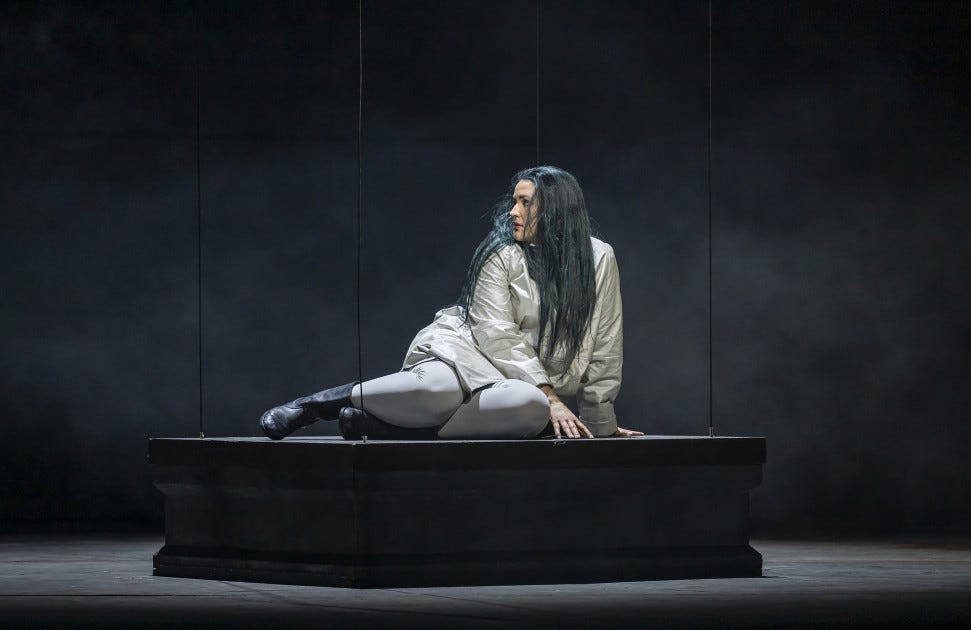
“A world where consuming and sex and stimulation is so over-the-top that it’s destroyed everything else,” director Lydia Steier says of her 2023 production of Strauss’s Salome for the Opéra National de Paris, likening her vision to a dystopia where the air is polluted and grass won’t grow. “It’s maybe us in 30 years,” she adds.
I was greatly persuaded by Steier’s vision for Salome, particularly her insistence that the heroine is not “a little girl who’s been abused and who’s weak,” a move that Steier describes as “spectacularly uninteresting.
“She does all of this very much on purpose,” Steier adds. “She has no other way to take down her father’s court, her mother’s court, the corruption, the decadence, the abhorrent, morally-bankrupt choices they’re making all the time. The only way she sees to destroy it is by essentially planting the bomb, and that bomb is the head of Jochanaan.”
(I’ve tried to not read too much into the fact that Steier’s production uses fashions from circa 1993 for Herod and Herodias’s court as my mother’s fateful Newport wedding took place at the end of 1992. It likewise did not make it through the decade.)
The idea, too, that Salome is about many things but it’s not a teenage girl driven solely by sex is an intention that goes back to Wilde. He did see her as an embodiment of sensuality, making her more than the “mute instrument” for her mother’s hatred of John the Baptist (which is how she’s originally portrayed in the Flaubert story that became the basis for Wilde’s play). “Her lust must needs be infinite, and her perversity without limits. Her pearls must expire on her flesh,” Wilde writes.
But he also saw Salome as the embodiment of chastity, with “nothing sensual in her beauty” and her pupils blazing with “the flames of faith.”
This is where Greta Thunberg (whose own mother is opera singer Malena Ernman) came into the conversation with Perri. At the time of our recording, Ernman’s name was mistakenly linked in the metadata to a 2008 English-language recording of Salome, and the idea of Thunberg herself as a regime-shattering Salome came to mind at the time. We were recording just a few weeks before Thunberg set off on the Global Sumud Flotilla (the second flotilla sent that year).
A few weeks after that, I watched as Thunberg and an acquaintance of mine from Berlin’s activism scene were both detained by the IDF and, a week after that, released—arriving in Athens in matching Ktzi’ot uniforms. Both women’s eyes showed flickers of the flames of faith.
Perhaps the most transgressive thing for Salome to suggest is how easily empires can fall. Kaiser Wilhelm, around the time of the work’s premiere, said that the work would do Strauss a lot of damage. Strauss would later quip that the “damage” allowed him to build his estate in Garmisch Partenkirchen. Construction on the Strauss Villa began in 1907. Just over a decade later, after spending World War I as a “shadow Kaiser” (in the words of one historian), Wilhelm II would abdicate the throne and accept exile in the Netherlands (though he momentarily held out hope that the rise of the Nazi Party would lead to a restoration of his dynastic line).
Strauss, too, was not spared the damages of the Twentieth Century. He initially cooperated with the Nazi regime, likely flattered by Hitler’s early admiration of his work, and also with a combination of professional and personal interest. His connections saved his Jewish daughter-in-law and grandchildren, although he was less successful with other members of her family.
He also watched as his friend and librettist for Der schweigsame Frau, Stefan Zweig, opted for exile, traveling from Britain to the United States to Brazil, where he ultimately ended his life in 1942 (Zweig’s own villa in Salzburg is now owned by the scion of the Nazi-coddling Porsche family). When American troops reached the Strauss Villa, he had the good fortune of introducing himself as “the composer of Rosenkavalier and Salome,” a reference that was recognized by one of the officers, who was also a musician.
Despite these strokes of luck, Strauss remained bleak. “The most terrible period of human history is at an end,” he wrote in his diary at the end of the War, “the twelve-year reign of bestiality, ignorance and anti-culture under the greatest criminals, during which Germany’s 2000 years of cultural evolution met its doom.”
Picturing Strauss writing those words in his Alpine village, I’m reminded of Edward Said a few years later, in a similar mountain town in Lebanon at the end of the summer of 1949. The dreariness. The mournful regret. The inevitability and repeatability of collapse.
The dread that runs through Salome isn’t tied to any one empire, or even any one century. It’s the recurring epiphany, usually realized too late, that collapse doesn’t announce itself as rupture. It comes disguised as excess. As spectacle. As something people attend in evening dress.
I loved the Met’s production of Salome last season with Elza van den Heever in the title role. Guth’s production didn’t shy from the abuse narrative (personifying Salome at different ages on stage and during the dance) but I found her to be similarly strong. Not sure if you saw, but for me it was the most Heavy Metal event I had been to since a Metallica concert in the 90’s
I've seen a number of Salomes, most recently Dimitri Tcherniakov's brilliant staging at the Hamburg Opera with Asmik Grigorian, the Salome of this century. There is very much a Gilded Age feel to this staging, part of a trilogy of Strauss operas that Tcherniakov has set in a wealthy patron's mansion akin to the Gilded Age (or the Wilhelmine period). I also loved the Salzburg Castellucci Salome, but more for Grigorian and her delightfullly petulant performance than for Castellucci's staging. But the strangest Salome I ever saw was the Luc Bondy production in Salzburg when I was living there. I often attended open dress rehearsals, but this one was completely booked, so the stage manager allowed me to climb to the top of a ladder just inside the proscenium where I had an eagle-eye view of the stage below. I was so close that the decibel level of the orchestra and singers (including Catherine Malfitano, Hanna Schwarz and Bryn Terfel) was like bathing in sound. I could peer down into the hole where Jochanaan was reading the score to prepare for his cues. But weirdest of all, was the most dramatic moment in the opera, when suddenly a rat calmly walked out onto the stage. It meandered through the singers (who commendably ignored it) and finally stepped out over the net that partially covered Jochanaan's hole, before disappearing into it. The stage manager later told me it wasn't a rat, it was 'unser Siebenschläfer' or 'our fat dormouse'.