

Rage, Goddess
The hazards of writing a Maria Callas biography go beyond separating fact from fiction
This was originally a subscriber bonus for Maria, Medea, and Midsommar. For more context, I recommend reading Part 1 and Part 2 of that essay.
With a nearly-7,500 word final product, it would seem like I’d be hard-pressed to find anything else to say about Pasolini’s Medea, the various ways it connects to the long line of feminine rage in performance (culminating with Ari Aster’s Midsommar), and the added context of its star, Maria Callas, and how her own rage was painted in the press and subsequent biographies.
And yet…
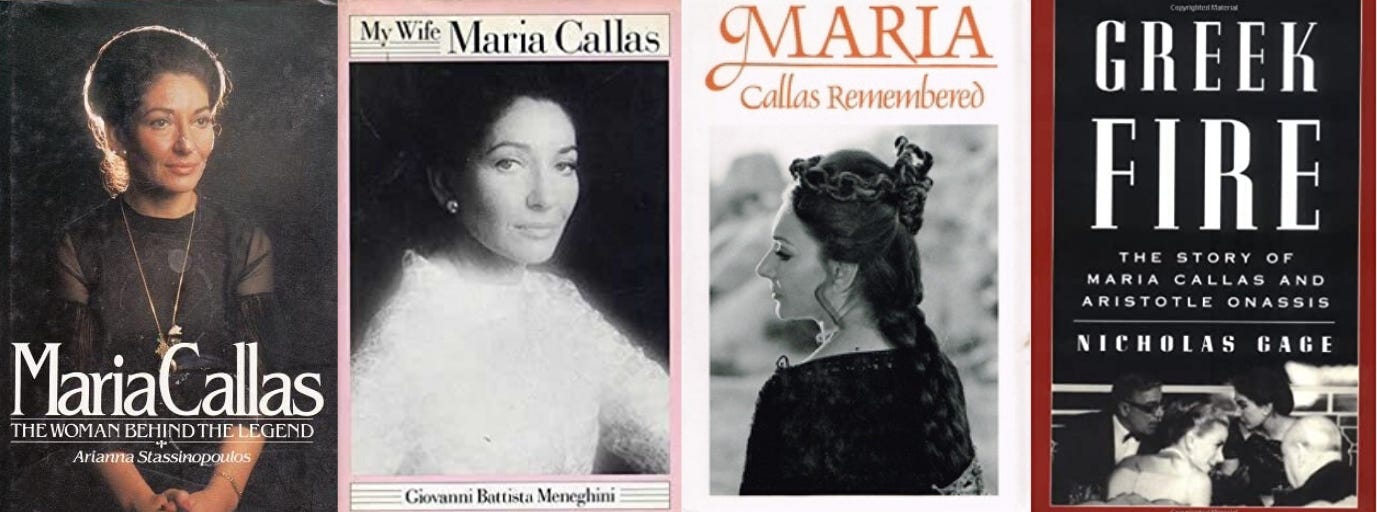
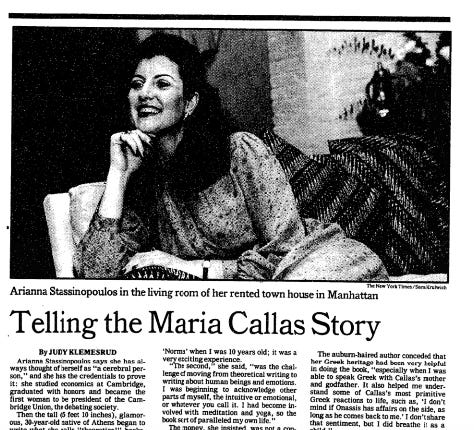
One of the first “definitive” biographies about Maria Callas was written by a fellow Greek-born woman, Arianna Stassinopoulos. Stassinopoulos was 27 when Callas died. A Cambridge graduate in economics, she was working in London as a journalist and TV commentator when she received a call two days after Callas’s death with an invitation to write the diva’s biography. She had already published several books, including The Female Woman, which was read in its time as anti-feminist (despite the author’s insistence that her argument was more nuanced, saying “you don't need to denigrate a traditional female function like motherhood in order to exalt another”). She had only seen Callas perform live once, but ultimately agreed.
Published in 1980 in Europe and 1981 in the United States, Maria Callas: The Woman Behind the Legend was billed as meticulously researched, encompassing nearly 300 interviews, including a conversation that Stassinopoulos managed to finagle with Evangelina Callas (Maria’s mother). It immediately became a blockbuster: Long before the Internet rumor mill began to run on a 24-hour flow of grist, the details surrounding Callas’s affair with Onassis (and Onassis’s subsequent marriage to Jacqueline Kennedy) were largely unknown by Callas’s larger fanbase.
What struck me most about Maria Callas: The Woman Behind the Legend, however, was the empathy it held for Callas, empathy that was seemingly before its time.
“What emerged time and again,” Stassinopoulos writes in her introduction to the book, “were valid, often tragic reasons for behavior that at the time and in later accounts was explained purely in terms of bad temper, impossible demands and vanity. Still more important, these discoveries revealed the conflict within Maria, a split which she unceasingly yearned to heal.”
This image of Callas’s internal split gibes with what Callas herself told David Frost on his talk show:
“On the whole, there are two people in me. I would like to be Maria, but there is the Callas that I have to live up to, so I'm coping with both as much as I can.”
(When Frost asked, in a pinch, who would win: Maria or Callas, she replied: “I like to think that they both go together, because Callas has been Maria. In my singing and in my work, my whole self has been there every second.… If somebody really tries to listen to me, seriously, one will find all of myself in there.”)
Stassinopoulos’s biography was what prompted Maria’s ex-husband, Giovanni Battista Meneghini, to write his own memoir, My Wife Maria Callas. In his own introduction, Meneghini says he would have rather not authored the work, but that he felt it was his “duty” to defend his late ex-wife’s memory in the wake of her biography. He also claims that Stassinopoulos never got in touch with him in her research, despite including quotes from him from other sources in her book. “It seems to me that this is enough to justify my indignation,” he concludes.
As I mentioned in the first part of Maria, Medea, and Midsommar, reading Meneghini’s biography now in 2020, it’s hard not to read more self-congratulatory and self-serving reasons for him putting pen to paper. Not that Stassinopoulos doesn’t include some salacious details that may not best serve the Callas narrative, but at least her book isn’t the late-20th–century equivalent of a 200-page subtweet.
And yet, the coverage from its time tells a different story. Setting aside the claims of plagiarism leveled against Stassinopoulos (which were settled out of court “in the low five figures,” a case that left one of Callas’s biographers to become close friends with Stassinopoulos), Maria Callas: The Woman Behind the Legend — along with its subject — took a critical backlash in the wake of its $1 million success, Book of the Month Club inclusion, and talks of a Ken Russell adaptation.
Writing for the New York Times in 1981, when the book was released in the States, Donald Henahan qualified it as “a fascinating social document in its way.” That “in its way” does a lot of work for the subsequent review, which characterizes Stassinopoulos’s book as “a model of how to destroy a career.
Far more harsh was musicologist Joan Peyser, who called Stassinopoulos “the London equivalent of America’s Marabel Morgan,” took the author to task for producing “a biography loaded with detail, high on hyperbole and lacking in objectivity,” also noting that, “[h]owever frivolous this book may be, Callas was in no way frivolous.”
To be fair, these are valid reads on Stassinopoulos’s book, perhaps even fortified by the fact that Stassinopoulos hadn’t covered arts and culture in any significant way prior to The Woman Behind the Legend. But her research was nevertheless rigorous (including receiving hundreds of letters that Maria sent to her godfather, Dr. Leonidas Lantzounis.
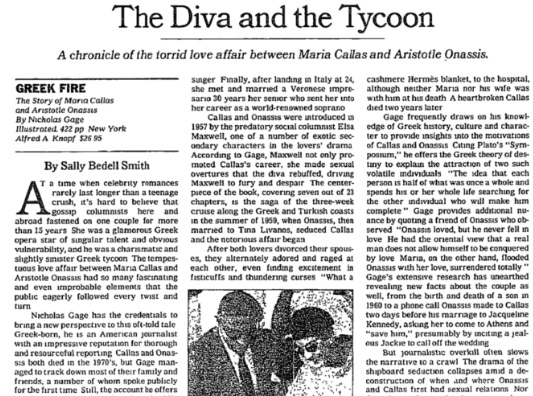
In fact, Nicholas Gage’s 2000 book, Greek Fire: The Story of Maria Callas and Aristotle Onassis (which makes the claim that the couple’s illegitimate love child was born in Milan and died the same day), receives none of the claims of frivolity and is in fact criticized by the Times for how much research was disclosed. Without any question of objectivity, hyperbole, or frivolity (which can be argued is as present in Gage’s book as it is in Stassinopoulos’s), Sally Bedell Smith concluded “after years of erroneous accounts about Onassis and Callas, not to mention their own embroidered versions of their lives, Gage diligently sets the record straight.”
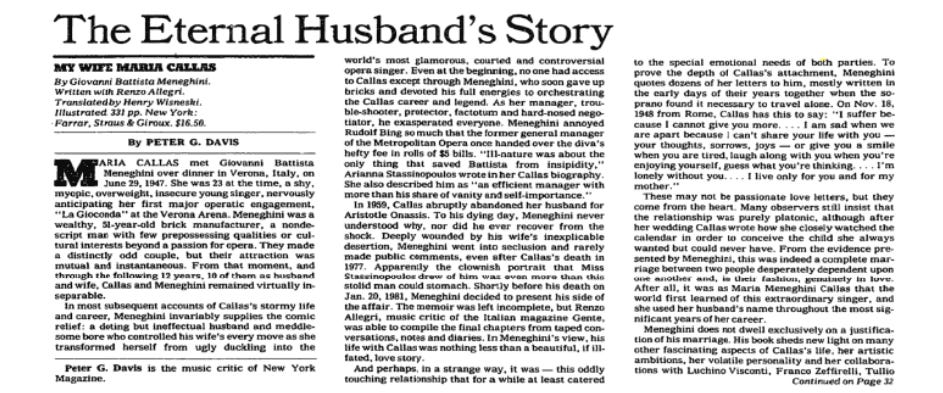
More contemporaneous with The Woman Behind the Legend was Meneghini’s memoir, which was reviewed in 1982 by the Times’s long-serving music critic, Peter G. Davis. “In Meneghini's view, his life with Callas was nothing less than a beautiful, if ill-fated, love story,” Davis writes. “And perhaps, in a strange way, it was.”
Where even in Meneghini’s own memoir we can read into controlling relationship behavior that is unhealthy at best (such as his orchestrating a reunion with Maria and her abusive mother without his wife’s knowledge), in 1982, Davis read this behavior as that of “a doting but ineffectual husband and meddlesome bore who controlled his wife's every move as she transformed herself from ugly duckling into the world's most glamorous, courted and controversial opera singer.”
The book is further praised, while continuing to paint Callas as the tigress, when Davis concludes: “this loving account of [Meneghini's] life with a woman he never really knew is a poignant document, a much sadder one than this bewildered man ever realized.”
Of all of the biographies and memoirs I’ve read on Callas, I empathize most with Nadia Stancioff’s book, which is part-memoir, part-biography recalling Stancioff’s years as Callas’s assistant as well as her attempts to piece together Maria’s life after her death. The objectivity we expect with a biography is excused in this format, and she seems as confused as any of us are when faced with so many conflicting facts and myths. Here, Kirkus used the phrase “gossipy but relatively tasteful” in its review. “Gossipy” is a word attached to The Woman Behind the Voice as well, but not mentioned in the Times reviews I read of Meneghini or Gage.
At this point, it’s also worth noting that Stassinopoulos and Stancioff are both women, whereas Meneghini and Gage are men. All four books are as subjective and worthy of criticism in their own way. But it’s hard to not consider the fact that, at the end of the 20th Century, male writers still got away with a lot more than their female counterparts.
Who gets to tell the stories of other people? Who gets to control the history of origins? The story of Maria Callas is the story of a mythical woman being forced to live out her very human emotions on a global stage. The ramifications of those emotions, which have since woven themselves into venerable legends and camp anecdotes, are — as we’ve seen — unique to Callas’s own gender. But we can also see that the ramifications of others telling that story are gendered all.
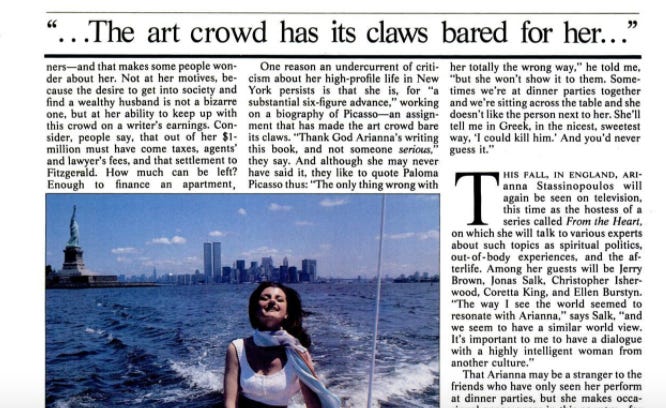
Coda: In the case of Arianna Stassinopoulos, those ramifications continue to play out. Like Callas, she married a wealthy man. Her achievements in life were equated with that marriage, as well as her connections to others who handed her undue opportunities (including the Callas biography). A 1983 feature in New York magazine titled “The Rise and Rise of Arianna Stassinopoulos” may as well have been titled “L’incoronazione di Arianna.”
Stassinopoulos would be forgiven for writing off the article’s author, Jesse Kornbluth, for his takedown. Yet in a follow-up published by New York in 2006 by Emily Nussbaum, we learn that the two are now friends.
Of course, Jesse — along with the rest of us — now refer to her by the name she took in her marriage (and kept after her divorce): Arianna Huffington.