

Not Like Us
Rereading Kira Thurman's "Singing Like Germans" in an era of queasy prophecy.
Stay with me on this one: On December 28, 2021, and January 3, 2022, twin brothers Grichka and Igor (respectively) died of covid in Paris. Born into an aristocratic lineage, the brothers and French TV hosts amassed a mad libs sort of legacy by the time of their deaths.
They were famous around the world for their extensive use of botox and plastic surgery, both of which they denied using. They received dubious doctorate degrees: Grichka in mathematics, Igor in physics. They courted controversy for publishing incomprehensible papers about the state of the universe before the Big Bang that were believed to be hoaxes, an act that earned the nickname “L’Affaire Bogdanoff.” They later became professors of cosmology at alleged Serbian diploma mill Megatrend University (yes, that’s actually the name). Later in life, they claimed that they had written some of the original source code for Bitcoin and that Satoshi Nakamoto had given them a pair of “ancient,” physical Bitcoins.
One constant in the Bogdanoffs’ lives is that both were seemingly in control of their own narratives. When faced with accusations of sloppy science, they sued for libel. Their eventual pop-science book based on their academic papers, Before the Big Bang, became a bestseller in France despite the factual shortcomings. “Though often mocked as comically repulsive, they continued to mix with elite French society, dating models and heiresses and making the rounds during gala season,” Clay Risen wrote in their joint obituary for the New York Times. “The brothers denied ever undergoing cosmetic surgery, insisting instead that their changes resulted from their dabbling in unspecified ‘technologies.’”
If this all sounds a bit operatic, there’s a connection there, too: The maternal grandfather of the brothers Bogdanoff was American tenor Roland Hayes. Born in 1887 in rural Georgia to formerly-enslaved parents, Hayes’s musical talents against the backdrop of the Jim Crow South led to him finding a career abroad in Europe. He’s one of the many Black American musicians who did this during the late 1800s and early 1900s detailed in musicologist and historian Kira Thurman’s Singing Like Germans: Black Musicians in the Land of Bach, Beethoven, and Brahms.
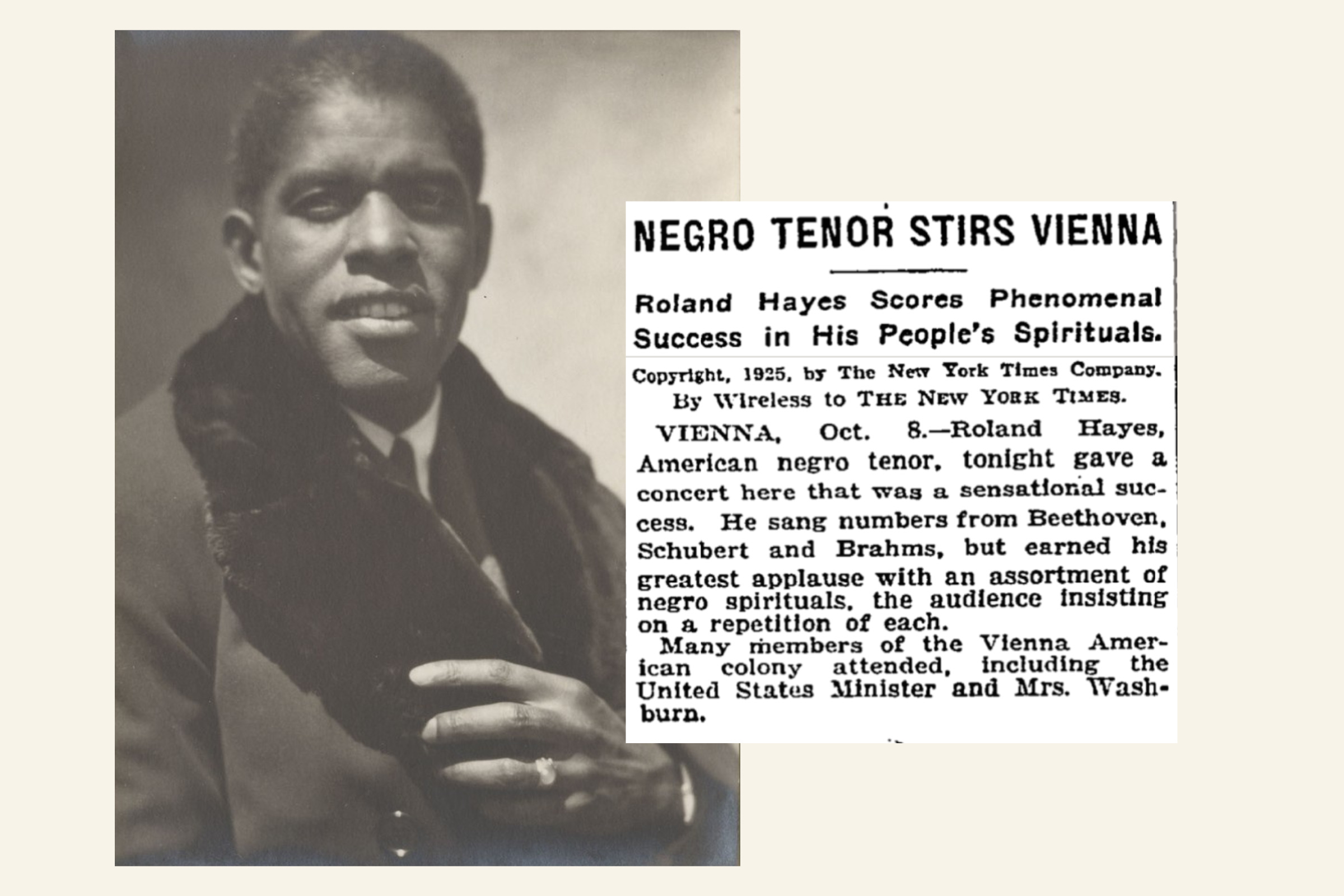
“In that time I had learned to love those hospitable, unprejudiced, pre-Hitlerite Germans, to worship Beethoven, Wagner, and Joachim,” said composer, conductor, and violinist Will Marion Cook, who studied in Berlin at around the time of Hayes’s birth (1887 to 1889). He, like many of his compatriots, found relief from racism, which stretched across the Mason-Dixon line in the wake of the Civil War (to tie back to last week’s post, Florence Price was encouraged by her mother to “pass” as Mexican when she studied at the New England Conservatory of Music).
But Singing Like Germans (which I reviewed at the time of its publication for the Los Angeles Review of Books) does as much to problematize the universal humanity attributed to German and Austrian music as it does to contextualize it. Thurman’s book is a monumental history tangled with historical cameos and main characters, points and counterpoints. It’s not so much that she attempts to untangle the knotted history as she does to trace the contours of those knots. For the musicians themselves, they were more often seen as curiosities than serious performers, a limitation — as Thurman points out — of the idea of German musical universalism. Though critics could often debate the true nature of musical Germanness, “they all nonetheless believed Blackness lay outside of it.” This also warped public perception of musicians, with that perception shaped by the prevailing German and Austrian attitudes towards the United States.
In this way, Hayes landed in Berlin at the wrong time with a scheduled concert in 1924. World War I had ended less than six years earlier, as did both Habsburg and Prussian rule. In addition to American troops still stationed in the country, Germany was also occupied by French colonial forces, soldiers drafted from colonies in northern and western Africa. In the Weimar Republic, the presence of these soldiers became known as the “Black Horror on the Rhine,” which Thurman cites as the first significant example of how anti-Black sentiment became embedded within German society after the war. “The Black Horror threat — and, more important, the cries of hysteria from white Germans about it — placed Blackness in a negative and threatening light,” she writes.
White German women were under threat, as was German culture: Thurman quotes a speech from far-right German political leader Hermann Schuster given a year before Hayes’s Berlin recital: “Music is the most German of all our arts. None has emerged as specifically from our cast of mind as has music. At the same time, music is the art most capable of serving propaganda for us abroad. It is at once the most German and the most international of the arts, and is best able to contribute to the restoration of our honor and esteem in the world.” Its greatness was both a soft-power for Germany to wield on the world stage, and the reason that same power needed to be protected from international actors.
By the time he performed in Berlin, Hayes was hitting a high point in his career with international acclaim and a following of (white) aristocratic patrons. He would end the decade making approximately $100,000 a year. Yet his Berlin recital was protested, even before he arrived in town. Germans gathered outside the American Embassy to voice their disgust, others put it into writing with editorials in the German press. In their own biography of Hayes, Christopher A. Brooks and Robert Sims quote one letter to the editor that said the best the star tenor could do is “remind the German public of ‘the cotton fields of Georgia.’” The American ambassador to Germany declined to attend the concert and recommended that Hayes postpone it until American troops had withdrawn from the country.
Instead, Hayes went ahead with the performance. A ten-minute outcry as he took the stage was eventually brought to silence: “It was so quiet, according to Roland, ‘that the hush began to hurt,’” write Brooks and Sims. Out of that silence, he began to sing Schubert’s “Du bist die Ruh”: “You are the calm, the mild peace/You are the longing and what quells it.” The roar from the audience picked up again after the song, but this time it was in acclaim, not protest. (Not one to let this story be so neatly wrapped, Thurman notes that one review attacked his choice of German lieder: “While he may understand modern music, it would be impossible for him to interpret the cultured works of German poets, since he speaks out of the soul of his aboriginal people.”)
Collectively, the devils in the details of this episode from Hayes’s career form a microcosm for how German reception of Black classical musicians shifted between the wars. What had been pleasantly exotic at the turn of the century had, among fallen empires and economies, become “a threat to Austro-German culture,” without any changes happening in the quality or sincerity of performances onstage. Hayes’s success now presented a threat, both for the financial security his concert fees in Central Europe afforded him and for the figure he cut as an attractive performer in his late 30s.
The affair Hayes had with a married countess, Bertha Kolowrat-Krakowská, led to a pregnancy — one that Brooks and Sims imply Kolowrat-Krakowská wanted to have as a statement in favor of mixed-race children. Whether or not that was the narrative Kolowrat-Krakowská was indeed aiming for, the one that was delivered was of Hayes as a sexually dangerous and deviant Black man (that daughter, Maria Dolores Franzyska Kolowrat-Krakowska, would give birth the Bogdanoff twins in 1949).
Thurman points to the title character of Ernst Krenek’s 1927 opera, Jonny Spielt Auf, whose title character, a Black jazz musician, is moved to an almost mephistophelean degree by women and money. Thurman links Hayes to the Jonny archetype, “ultimately proof that Black men are sexually deviant, perhaps diseased, and that they ultimately cannot be trusted.… Unlike real artists, who exist only to serve art, Hayes was a greedy and manipulative Black trickster who thrived on deviance and manipulation.”
In a direct parallel to the messaging we’ve seen in 2025, one 1920s German right-wing paper accused Hayes of taking jobs away from “German artists who have undergone long years of training [and] are starving.” Ultimately, Thurman writes, “the Black Horror trope worked to foster an ‘us vs. them’ dichotomy that depicted the civilized and cultured German at the mercy of the savage and primitive Black man.”
Hayes was not a unique case, and the pushback became only more severe as National Socialism began to dominate European politics. In 1932, baritone Aubrey Pankey was scheduled to perform a recital in Salzburg. Nazis papered the city with flyers and attempted to storm the Mozarteum, singing nationalist songs outside the concert hall as an act of protest. Two years later, Paul Robeson encountered a similar sentiment in Berlin, one that his wife Essie described as “a terrible feeling of wolves waiting to spring” that bore an uncomfortable resemblance to the Jim Crow South. Many Black artists left Europe for fear of their safety; many who stayed wound up in prison and concentration camps, a fact that is still not widely known even among Germans.
This is both a symptom and a product of German Erinnerungskultur, which translates literally as a “culture of remembrance” but, especially in the last two years, has been invoked readily and repeatedly by politicians and pundits who seem to have forgotten the main point of this historical memory: a commitment to recognizing genocide when it is once again perpetrated, and committing to never letting it happen again. As journalist James Jackson wrote a few days ago, “Only in Germany can you justify banning languages and brutalizing protesters by saying you learned from your dark history.” This accompanied a post from a neoliberal politician who invoked the Shoah while describing protesters demonstrating against the ongoing genocide in Palestine as antisemitic.
Meanwhile, last month, German parliament approved a resolution designed to drastically restrict migration to the country, notably for migrants of color. The resolution was achieved by cross-party cooperation with the far-right AfD, a rubicon that German politicians had previously refused to cross given the AfD’s connections to right-wing extremists and neo-Nazis. (“The problem is that Hitler is portrayed as absolute evil,” AfD leader Björn Höcke has said.) These days, a common response on news stories about migrant families in the German press, particularly those from the Middle East and North Africa, from readers is “February 23,” a reference to the next federal elections and the idea that such “non-Germans” would be deported following a predicted shift to the right.
Revisiting Thurman’s work in this light is queasily prophetic. Even upon its publication in 2021, I was aware that many historical problems remain present; many of my margin notes around “performances of cultural citizenship” on the parts of Black classical musicians link to that same cultural citizenship being performed today by refugees and migrants in Germany. But the situation has devolved in the subsequent three years, revealing that the true culture here is not of memory, but of forgetting. Or — and I can’t decide if this is better or worse — of revising historical memory.
This, too, isn’t new. In 1945, after the war, Guyanese conductor Rudolph Dunbar became the first Black conductor to lead the Berlin Philharmonic. Despite some protest over Dunbar’s ability to command the repertoire straight out of the Hayes/Pankey media cycle, his debut was overall a success. Not in the least, as Thurman put it, for allowing Germans “to avoid culpability and to flee responsibility for their actions through the experience of emotional catharsis.” Even members of the Philharmonic had found ways of absolving themselves, discovering that they had been “duped,” as Thurman puts it, and seeing themselves “as victims of Nazi cultural politics” without ever stopping to think about their own complicity under fascism.
Historians, Thurman writes, “operated under the assumption that the problem of racism disappeared after the demise of the Nazi state.” She points to scholar Katrin Sieg, who views this act as deliberate: “The work of forgetting faces a conceptual dilemma: how to forget something you cannot acknowledge knowing, since that acknowledgment would consign matter to memory rather than oblivion?”
In the post-war era, these patterns would continue to play out. In 1961 (the same year that the Berlin Wall went up), Wieland Wagner cast Grace Bumbry as Venus in Tannhäuser at Bayreuth, which provoked another outcry while also serving to rehabilitate the festival’s image as a Nazi fairground. That same summer, in Salzburg, Herbert von Karajan hired Leontyne Price to sing in Don Giovanni, which led to a rock going through the window of Price’s hotel room. Thurman doesn’t see these castings as accidental or entirely virtuous on the parts of Wagner and Karajan: In a “post-race” Germany, one where mentioning the Holocaust was also taboo, Black people became “symbols of rehabilitation and repentance in order to process [the] past.”
Things weren’t much better in East Germany. After the war, Aubrey Pankey ultimately made his home in the German Democratic Republic. Yet he found himself increasingly cast in the role of singing spirituals, despite a career in lieder and opera. One critic complained that one of Pankey’s recital programs only contained a handful of spirituals and was too dominated by traditional lieder and aria repertoire. Pankey shot back, complaining to both the press and East German cultural officials: “Your reporter has assigned himself the task of politically analyzing my program. His ideas regarding my political and cultural obligations towards my people are actually and effectively racist,” Pankey wrote in a response to the review. “I consider it a serious political problem when a music critic of the GDR sings the same tune as white chauvinists. They are the ones who ask Negro singers to limit themselves to singing spirituals.”
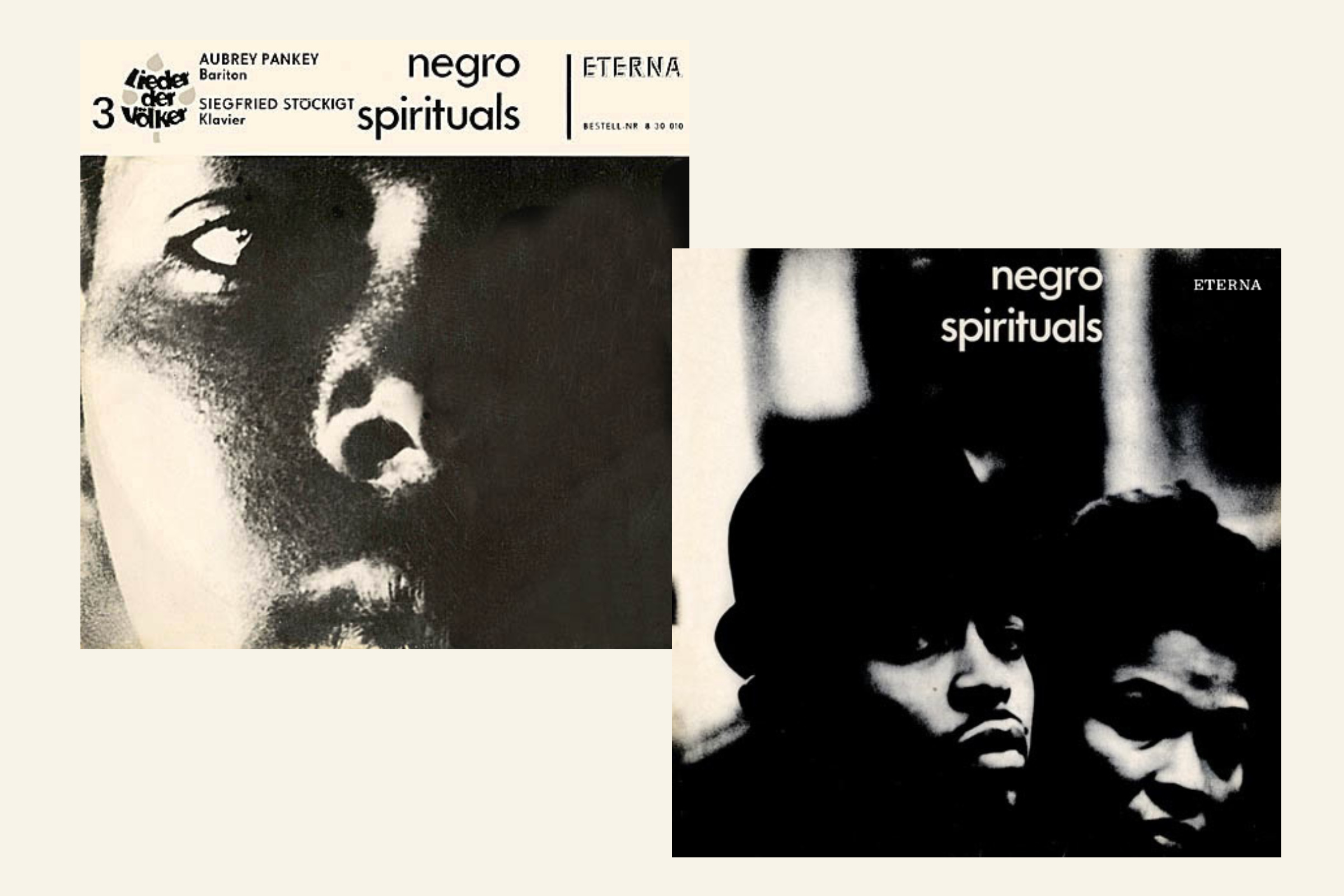
Whatever legitimate acceptance East Germans had for Black people was overshadowed by racial tolerance as a political move, offsetting Communist and Socialist states against the violence of America during the Civil Rights Movement and a rapidly de-colonizing Africa. To this end, in the final months of the GDR, one sign popped up at a Monday night protest: “Germany for Germans, Blacks out of the GDR.” A few months later, the Berlin Wall fell, and the popular reception of Black classical musicians in the cities that were once part of the GDR (including Dresden and Leipzig), fell with it.
Reading that section of Singing Like Germans this week stopped me in a way that it hadn’t the first time. Last May, a group of (white) German vacationers on the island of Sylt were recorded singing a song that cast new lyrics to Gigi D’Agostino’s “L’amour Toujours”: “Deutschland den Deutschen / Ausländer raus.” The second part, a former Nazi slogan, means “Foreigners out.” Unmistakably, the first part translates to “Germany for Germans.”
Loved this piece bc I knew next to nothing about this topic. Thanks for sharing!
Fascinating!