

Inheritances
Some very belated notes on a piece I wrote for Harper's in February
Before we get into things, a special announcement: I now have a podcast! Decanonized is an opera podcast where the sacred is subjective. I’ll be sharing more on this in a future post, but in the meantime you can tune in on Apple Podcasts, Spotify, Patreon, or your podcatcher of choice.
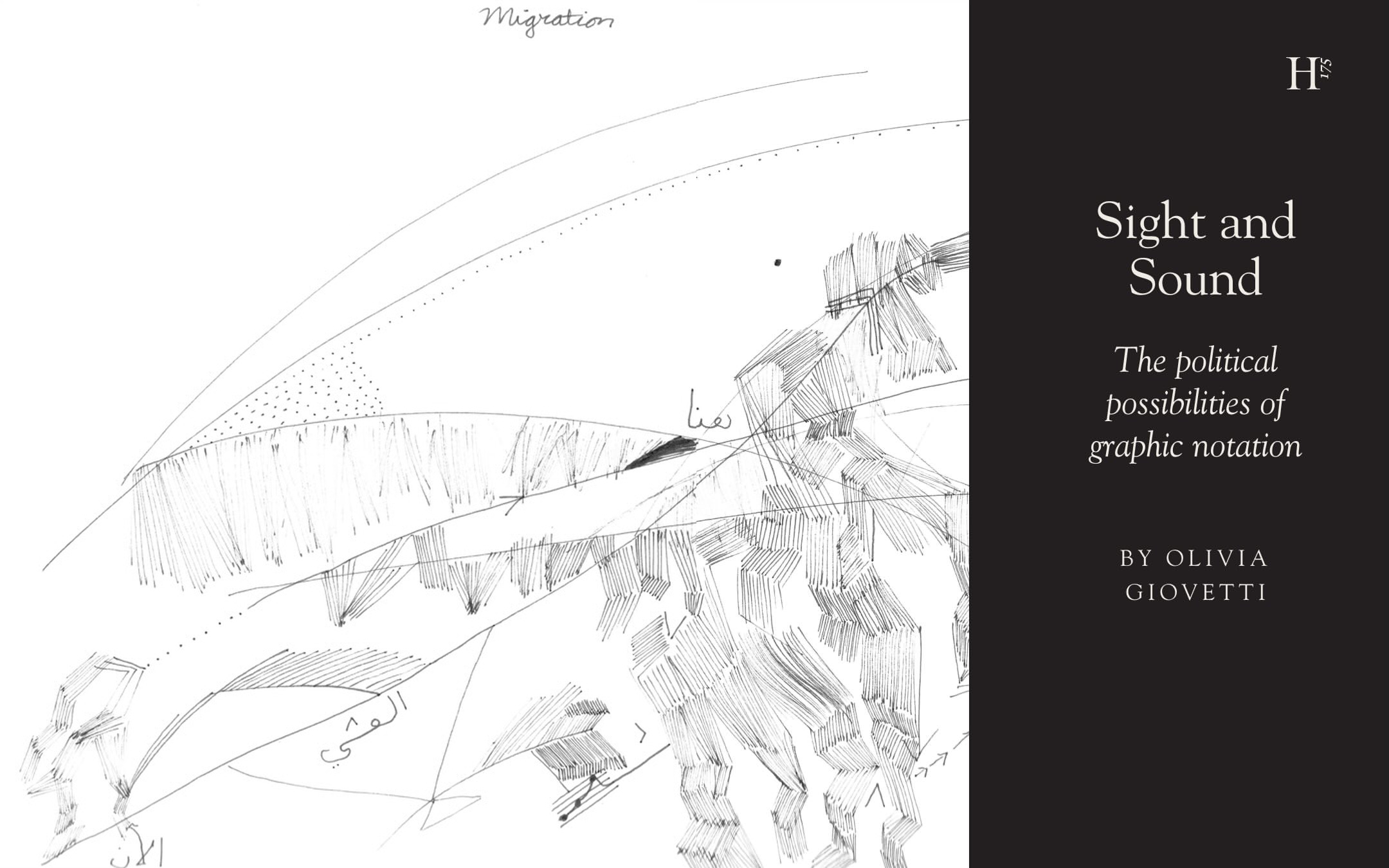
Back in February (which gives you a sense of how behind on 2026 I currently am), I published my first article in Harper’s, an Annotation on Muyassar Kurdi’s “Migration” that traces not only this wonderful work by a composer-performer I greatly admire, but also the broader history of graphic notation over the last 80-ish years. It was also a personal work for me as well. Like Kurdi, the who was born in the United States to a Palestinian father and a French-Swiss mother, I was born in the US to a Syrian mother an an Italian father. The inheritances and lineages are complex. Much in the same way Kurdi traced her Arab lineage through “Migration” (in the broader work A Daughter of Isis), I felt I was tracing a similar series of fractals and fractures in writing this Annotation.
My central argument in the piece is that graphic scores are increasingly turned to in times of political turbulence and social upheaval, beginning with the revival of the form in the paranoid Red Scare years following World War II. Difficult times breed furious art. I’m hugely grateful to the Harper’s team, which were a dream to work with, especially Megan Evershed who helped me refine this idea from pitch to publication.
We’re already a few issues ahead of February, but we’re at no shortage of turbulence or upheaval. We’re also at no shortage of politically-hued graphic notation — just recently I saw a graphically-notated version of Willie Nelson’s “Red Headed Stranger” from another excellent musician and thinker, Clarice Jensen. While “Red Headed Stranger” itself isn’t a directly political work, it’s also a song with a history — and can any Willie Nelson song be extricated from his gospel of progressivism?
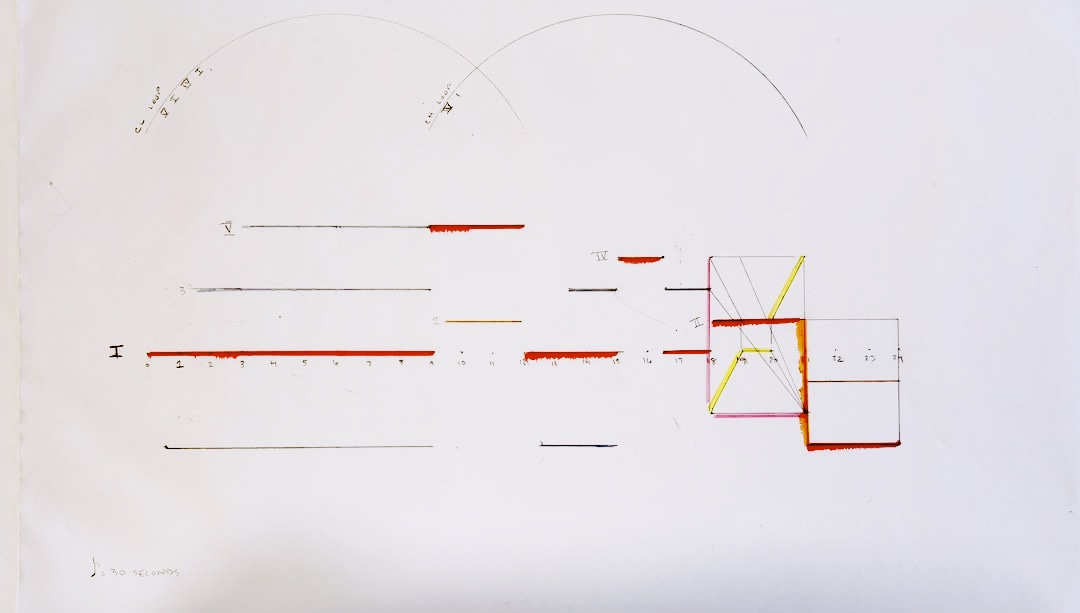
For those who want to claim that there is an apolitical dimension of absolute music, it’s harder to make that argument with graphic works. Ethan Philbrick, whom I also spoke with for this piece, helped put this into words, linking the move to graphic notation throughout the last century as a reaction to “the impossibility of working with things as they are, because the things as they are have become unbearably clear in their brutality.” In such times, when artists try to address reality in their work, Philbrick adds, “they’re pushed to the limits of the [musical] sign system. And so graphic notation reemerges at these different moments.”
That was something I wish I’d had more room to explore in the Annotation: the historical throughline in this new era of graphic notation (a form of music that dates back centuries and, one could argue, was even the original form of notation).
Most experts credit Henry Cowell as the forefather of the contemporary graphic score thanks to his own frustrations with the systems of standard notation. Born in 1897 to an immigrant poet and an anarcha-feminist (who divorced soon after), Cowell was 17 when began to study music under Charles Seeger — Pete’s father and a political activist in his own right. His influence is felt across New Musical Resources, which Cowell eventually published in 1930 but wrote while studying under Seeger. It’s this text that many cite as proof that the roots of modern graphic notation are at least in part from Cowell.
During World War I, Cowell served in the Army stateside, and Seeger lost his job at UC Berkeley due to his politics and opposition to the war. He moved to the East Coast, first to New York and later to DC, shifting his focus from composition to musicology and, during the Great Depression, taking several government jobs under FDR’s New Deal (including administrator with the WPA’s Federal Music Project).
Musicologist Malik Sharif argues that Seeger’s activism and New Deal work were inextricably linked with his own idea of musicology, “namely the increasing conceptualization of musicology as a socially-responsible and even applied or politicized discipline… [A] musicology that is socially-relevant in a tangible way, that tackles the questions of people outside of musical academia regarding contemporary musical life, and that actively engages in matters of national and international cultural and educational policy, instead of being a passive bystander.”
“He knows that if he irritates his subject enough, the idea will be remembered, and passed on,” Cowell wrote of his mentor. “And this is actually what happens.”
In his introduction to the collection Essential Cowell, Dick Higgins notes that Cowell’s writings often skirted the same Marxist sentiments that Seeger espoused, but that he was “not, however, a highly politicized figure.” He points to the 1953 essay “Music Is My Weapon,” where Cowell denies being a communist or having ever been a member of the party. However, Higgins adds that this was at the height of the McCarthy crisis and Cowell’s statements were likely calibrated towards that. Having spent four years in San Quentin prison on a trumped-up “morals” charge related to his sexuality, it’s likely that he had no intention of enduring a second persecution.1
Despite these challenges, as musicologist Richard French wrote in 1960, he “never recovered from the excitement of finding himself a composer.” I like to think of Cowell as a Willie Nelson-esque figure, with the same drive that has kept Nelson still performing at nearly 93: the belief that music could be a means of unlocking a more perfect union. It was one that Cowell grew up with himself, having lived as a child in San Francisco’s Chinatown at the turn of the 20th Century (ironically, he seemed in pursuit of this idea of unity while trying to find the most acute ways of dividing a musical note).
Cowell composed until his death in 1965, and taught the next generation of experimentalists, including John Cage. It was in Cage’s Lower East Side apartment that fellow composer Morton Feldman doodled a literal graph one evening in 1950 while Cage was cooking wild rice. That graph, with high, middle, and low planes, would become the basis for what many consider to be the first “real” graphic score of the era, Projection I. Along the spectrum of difficult times/furious art, I’m fascinated by Feldman being the one credited with (as Marcia Gay Harden’s Lee Miller tells Ed Harris’s Jackson Pollock) “cracking it wide open” when it comes to modern graphic notation. Feldman’s teacher was Stefan Wolpe, a Marxist who often locked horns with his young student over works that he deemed too esoteric.2
“I cannot make a relationship between music and society,” Feldman said in a later interview. However, Feldman — whose centennial also happens to be this year — was born in Queens to immigrant parents from Kyiv who worked in the garment business. He bristled at the suggestion (from a German music critic in 1972) that the moorland landscapes of his music were a response to the horrors of the Holocaust, which would have played out in Feldman’s impressionable teenage years and early adulthood. At the same time, he didn’t fully downplay history in his works, either — The King of Denmark, a graphic score from 1965, was inspired by King Christian X, who was on the throne when Germany invaded Denmark in 1940 and who, according to popular legend, wore a yellow star in solidarity with Danish Jews.
“Because I’m Jewish, I do not identify with, say, Western civilization music,” Feldman would later say. “What are our morals in music? Our moral in music is nineteenth-century German music, isn’t it?”
Cage, too, was not so easy to pin down politically which, in his own centenary year of 2010, Ina Bloom acknowledged was a “disappointment” to many. “Throughout his life, he performed an explicit Zen-style detachment from social and political ‘issues’ that served to deflect attention away from all questions of power relations, including those that would pertain to his own role and position, not to mention his compositions.”
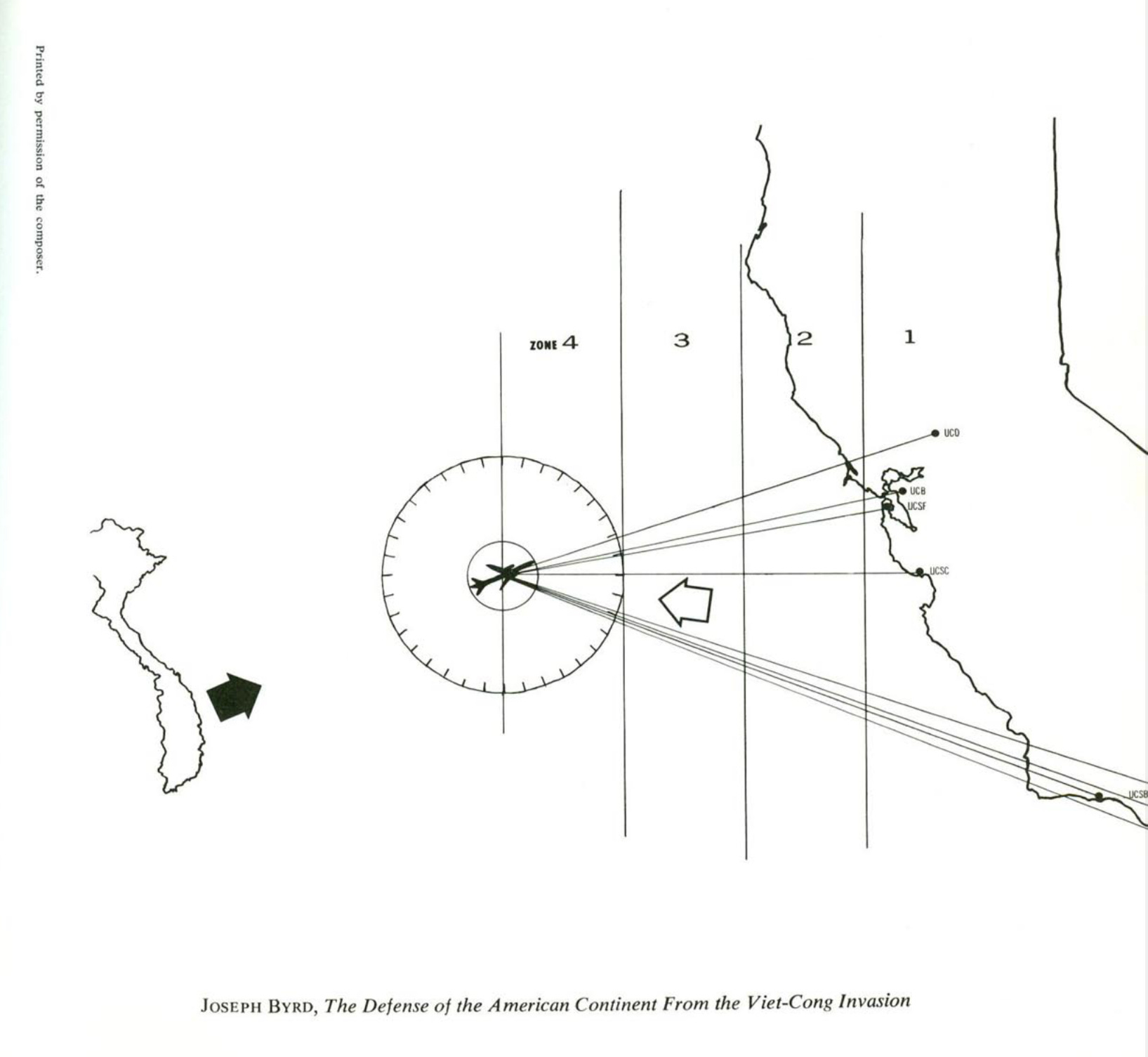
At the same time, it’s hard to imagine a Cage composition that wasn’t influenced by the material circumstances in which it was created. This comes through in his 1969 book, Notations, a collection of scores (many graphic or abstract) by nearly 270 composers, accompanied by short texts, quotes, and aphorisms. Dozens of these scores carry a political valence; how else to read a work like Joseph Byrd’s The Defense of the American Continent from the Viet-Cong Invasion? In his part of the text, Cage even situates graphic notation in a period of global flux that demanded a blowback against convention: “Where there is no choice, everything follows conventions.”
Interestingly, Cage was the one rattled by a break with convention in 1975 in a performance from his own work, Song Books. At SUNY Buffalo’s Baird Recital Hall, a young Julius Eastman took the stage to perform Solo for Voice No. 8. The instructions left plenty to choice: “In a situation provided with maximum amplification (no feedback), perform a disciplined action, with any interruptions, fulfilling in whole, or in part, an obligation to others.”
As John R. Killacky put it, “Eastman played his own queerness as an instrument in the performance.” He took on the posture of an academic, announcing: “My name is Professor Padu, and I’m here to show you a new system of love” while a Black woman and white man stripped and demonstrated a “sideways” system of making love that ran contra to the convention of “in and out.” Everyone in the audience, it seemed, was on board — except for Cage, who took Eastman to task immediately after the performance.
Of the works I wanted to mention in Harper’s and was unable to, the greatest loss was Eastman’s Buddha, an egg-shaped score of indeterminate length or order of notes. Two recent recordings, one from guitarist Sean Shibe and another from the ensemble Wild Up, show how vastly different the score can be interpreted (Wild Up’s members had such varying ideas that they actually released two different versions, subtitled “Path” and “Field”). Unfortunately, Buddha doesn’t fit in as neatly as some other examples of graphic notation that can’t help but be political (including elements of George Crumb’s Vietnam-era Black Angels and Penderecki’s Threnody to the Victims of Hiroshima).
And yet Buddha is a work that implicitly questions the ideas of self and no-self at a time when Eastman — who described his life’s mission mission as being “Black to the fullest, a musician to the fullest, and a homosexual to the fullest” — was living through the AIDS crisis, challenges to the Civil Rights Act, and overall Reagan-era indifference to anyone who wasn’t white, Christian, and nationalist.
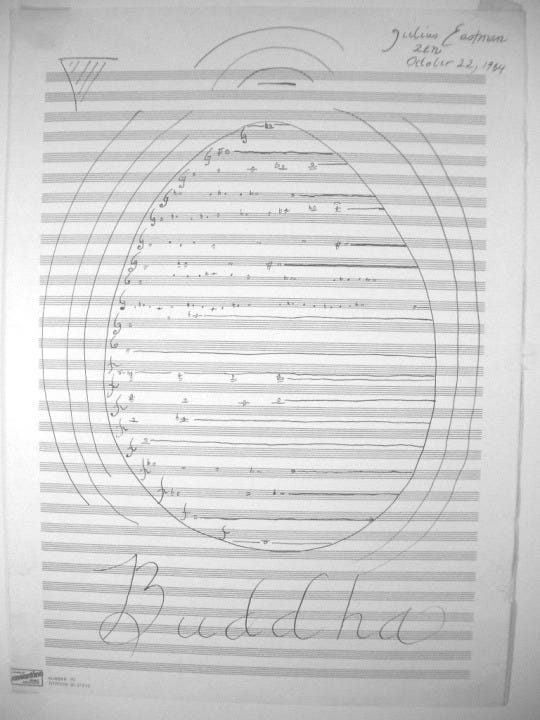
That’s a bit harder to spell out in the spatial constraints of an Annotation, but of all the scores I studied to write this piece, Buddha was one that reminded me most of Muyassar Kurdi’s own work (the two are also connected via Meredith Monk: Kurdi was a student of Monk’s, Eastman was the first male member of her ensemble). Both pieces balance the self and no-self of their creators against an incredibly capacious environment for performers to bring their own selves to the sandbox. And it’s this balance of both being in the world surrounding art but not so much within it that we veer into agit-pro that what makes these works so effective.
After the jump, as a paid subscriber bonus (THANK YOU!), some of my other favorite quotes from Notations, which also has a somewhat-modern counterpart in Theresa Sauer’s 2009 book, Notations 21.
