
Ghosts in the Machine
On The Galloping Cure and the question of how opera works
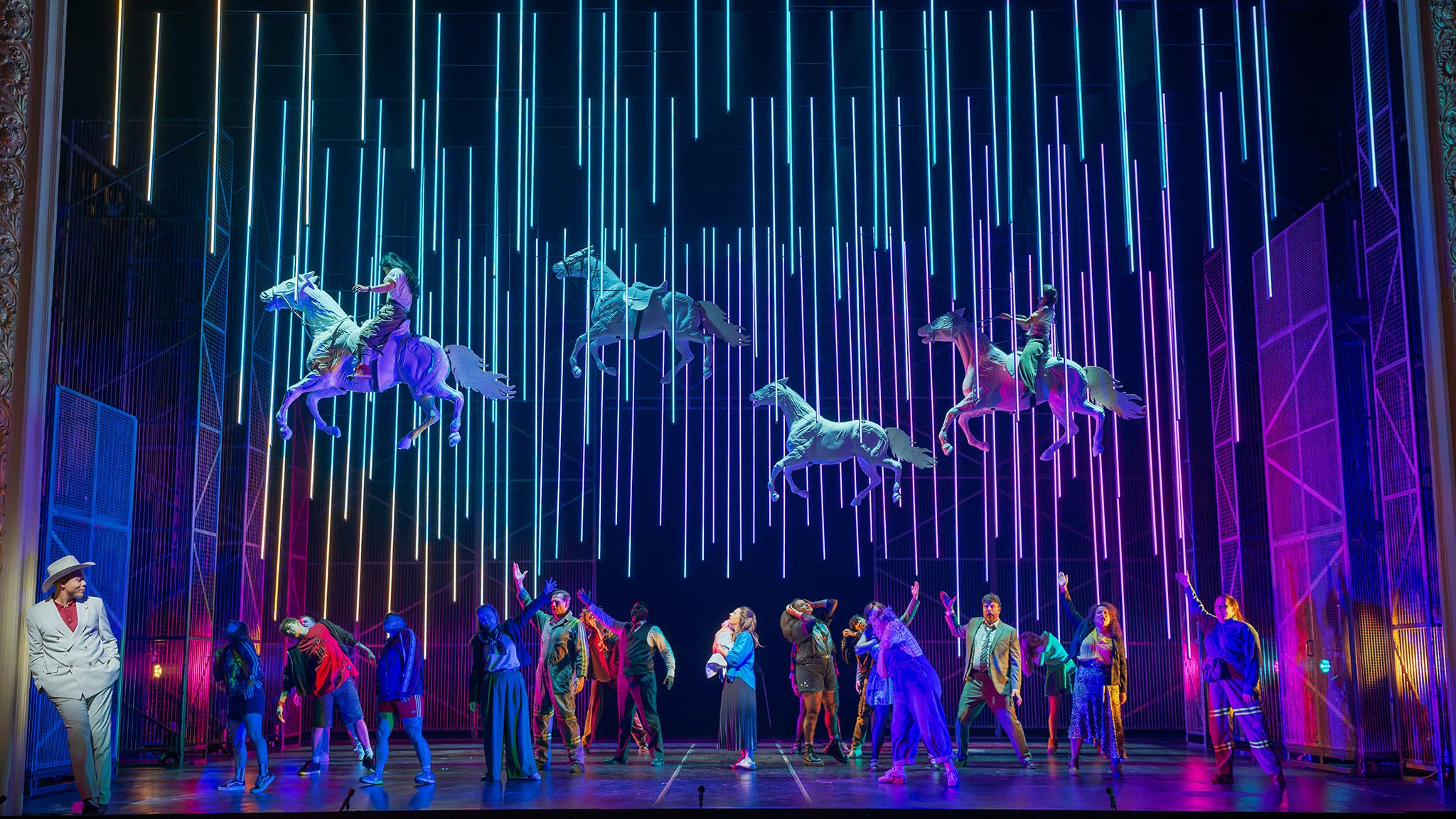
If you were in Edinburgh this week for the premiere of Missy Mazzoli and Royce Vavrek’s The Galloping Cure, you may have caught my program essay for the Edinburgh International Festival about opera’s capacity to grapple with the biggest human questions, which correlates with its ability to balance both a volcanic level of feelings and ideas while also zeroing in on certain emotions and stories with a miniaturist’s precision. As I wrote for EIF, “Its plots are both completely implausible and viscerally real. The stories it tells are both deeply personal, and universal case studies in love, power, betrayal, grief, memory, violence, politics, and faith.”
These contradictions are what gives opera its power. As Mazzoli said when The Galloping Cure was first announced in 2024, “its superpower is in its layering, communicating many things at the same time.”
Reading more of The Galloping Cure’s initial coverage while writing my program essay, I felt a sense of collapsed layers. The Guardian article that quotes Mazzoli above ran under the headline “Opioids the Opera.” That moniker has followed The Galloping Cure through to its run this week in Scotland, even though Mazzoli and Vavrek aren’t the first to tackle the subject of the opioid crisis. (In fact, this isn’t even Vavrek’s first opera on the subject — he also wrote the libretto for Michelle DiBucci’s Mrs. Winslow’s Soothing Syrup, which was workshopped in early 2020.)
“My father died from suicide due to alcoholism, but this piece also speaks to addiction in general,” Vavrek told The Guardian in 2024. “We carry our life’s experiences with us and, as artists, we synthesise them and try to reflect them in our work.”
Mazzoli’s own connections to the opioid epidemic were also referenced in the same article — two cousins, both of whom died of overdoses before they were 25: “Royce and I have several friends we’ve lost to addiction in their 30s. So it’s a very real thing for us.”
This feels like a marked contrast to the way other operas touching on this issue have been discussed; even the director of Mrs. Winslow told me in 2020,“The biggest thing with the subject matter is that you think, ‘It’s not me, and it doesn’t relate to me.” By contrast, the momentum of The Galloping Cure (admittedly based on the small bits that I’ve seen and heard of the work) seems to short-circuit that divide, driven by Mazzoli and Vavrek’s personal stakes in the story and made effective by the fact that they’re creating from the scar rather than the wound.
The more I thought about The Galloping Cure, however, the more difficult it became to answer the question: “What gives opera the capacity to grapple with the biggest human questions?”
That question sent me into the roots of Greek tragedy and Aristotle’s idea of catharsis, to peer-reviewed papers examining the psychophysiological effects of the art form, and to recent philosophical texts like Matthew Aucoin’s The Impossible Art and Yuval Sharon’s A New Philosophy of Opera. While all of these resources could confirm that opera grants us a special capacity, none could necessarily pinpoint exactly why. That superpower, the order and weight of the layers, ultimately remains as unknowable as the recipe for Coke.
In truth, the best explanation I could come up with was one I didn’t include in the program essay: At the age of 7, I lost my father to suicide when he walked into the waters off of Revere Beach and never came out. He’d left a note, but his body was never recovered. Because he and my mother divorced when I was young, his absence didn’t create a gaping hole in my life until seven years later, when he was declared dead in absentia and I received a copy of his will and a check from Social Security as his sole survivor.
It wasn’t until my late 20s, when I saw my first performance of Wagner’s Der Fliegende Holländer, however, that I began to consider my father’s somewhat dramatic disappearance. Opera, and Wagner in particular, is an artform famously linked to death (“Damn Richard Wagner, and his bellowings at Fate and death,” wrote D.H. Lawrence in one letter from 1911). But I had seen countless performances and most of Wagner’s canon before without ever bringing my father into the picture.
With Holländer, however, the synchronicities — a seven-year contract, a ghost doomed to the sea, a daughter whose fate is left to her father — lanced what I had thought was a long-hardened blister. The music was like a wave: fight against it, and you’ll be pulled under; work with it and you can ride the swell. I came out of the Met that evening feeling like I had managed to stay on my feet throughout the performance, exhilarated rather than exhausted by the force of it.
Just as artists bring their own life experiences with them to their work, audiences do the same. This isn’t to equate opera with therapy — having taken a sound practitioner training course about a decade ago, I’m wary of those who make a Big Pharma-like grift out of singing bowls and gongs. What happens in an opera house is more interesting and less prescriptive. The years I’ve spent in therapy encouraged me to sit with my emotions without holding onto them or attempting to change them. In opera, by contrast, I’m allowed to give those same emotions form and dimension while simultaneously abstracting them. As John Dewey writes in Art As Experience, “emotion is informed and carried forward when it is spent indirectly in search for material and in giving it order, not when it is directly expended.”
Funny, then, that we tend to reduce opera to its direct expenditure rather than its layers. The Galloping Cure becomes “the opioid opera” just as The Death of Klinghoffer becomes “the terrorism opera” or Innocence becomes “the school shooting opera.” It’s rare to encounter a production of Klinghoffer without protesters angry about displaying members of the PLO as humans. Innocence’s recent run at the Met prompted one critic to ask “Should a school shooting be turned into opera?”
But opera has never worked at face value. Its subject is only one of its layers, and often it’s the least interesting. The other layers come in with the people we bring us; the dead fathers and lost cousins, the artists trying to make meaning out of chaos, the audience members discovering something about themselves in the stories that aren’t theirs. Opera doesn’t tell us what to do with those layers; it shapes them into a wave that we can ride.
I like your layer theory, and especially your last paragraph, which hints at a less overt form of influence. I think Wagner's operas are more likely to worm their way into one's psychology than operas that pinpoint social ills. While the latter might seem more relevant (terrorism, school shootings, addiction), the former, i.e. Wagner's astonishing proto-Freudian insights about our interior landscapes, are able to profit from music that is as deep as those interiors require.
I loved this opera so much. It's about addiction through and through, including its very form, but that wouldn't do anything without the character created by Susan Bullock, Gabrielle Turgeon, and Daniela Mack.