
These last two weeks in Undone have looked at two sides of a Janus coin: making music in West Berlin just after the Wall had gone up, and making music in East Berlin just after the Wall had come down. In the case of the former, very little has been written on the historical or political significance of the Deutsche Oper Berlin’s Don Giovanni opening just over a month after the events of August 13, 1961. On the flip side, it seems you can’t write about the “Ode to Freedom” concerts without mentioning their place in the larger landscape of history.
I think about context and significance a lot these days as we live in an era whose historical landscape we are working to define, codifying and recasting in real time (often in bursts of 240 characters or less). Even before the current pandemic of COVID-19, these seemed like especially heady times to revisit two recent periods of similar uncertainty, in a city that was shaped by its division — which calls to mind Elaine Kelly’s phrase “the Janus head of a divided nation.”
Abby Anderton’s Rubble Music: Occupying the Ruins of Postwar Berlin, 1945-1950 covered a time period that ends over a decade before the building of the Berlin Wall and the Deutsche Oper’s reopening, but it was a wildly instructive and fascinating read for “Making Music in Isolation.” It’s thanks to Anderton that I came across the Hans Erich Nossack quote, likening bombed-out Hamburg to “scenery for a fantastic opera.”
Another aspect of this time that made it to the editing room floor, but deserves special mention, also comes from Anderton, who quotes the journals of aspiring actress Sabine K. Walking through the ruins of the Staatsoper (which had been leveled twice in the course of World War II), Sabine noted that the building “was as much my home as our flat and it should be made so once again.” This in and of itself came to mind when I revisited “19 Covid Theses” by Jeffrey Arlo Brown, Timmy Fisher, and Hartmut Welscher for VAN. In it, Brown in turn quotes Alex Ross in The New Yorker: “Audience-free concerts streamed on the Internet… cannot provide the bond that forms under the spell of live music.”
“Nor can they replicate the concentrated atmosphere that I, at least, need to really listen,” Brown continues. “In 2018, the musicologist Linda Shaver-Gleason wrote in VAN of contemporary concert halls that ‘our familiarity with this experience—not only in concert halls and opera houses, but in movie theaters—may have dulled our sense of how precious this inward-oriented listening experience would have been before the dawn of recorded sound.’ That sense is dulled no longer.”
I wonder what Sabine K.’s first trip back to the Staatsoper was like, both for the inward experience of listening, and for the communal nature of a live audience. For a city engulfed in trauma on a personal and national scale, I can only imagine what this listening experience must have been like.
Especially given that, as Anderton writes, while Allied forces attempted to bring their own national composers into the mix, German opera audiences wanted to explore “themes of civilian suffering through their staging choices. By hearing the city’s rubble in literal and figurative senses through operatic restitution, personnel decisions, and repertoire selection, civilians used opera to stage occupier-sanctioned forms of German victimhood.”
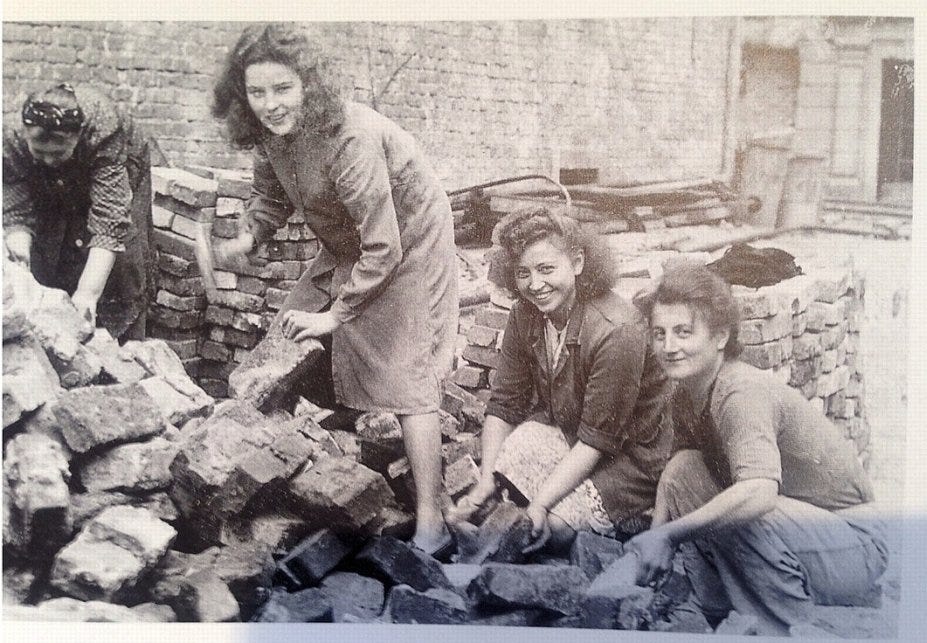
That victimhood, in turn, was particularly focused on women who, even when their partners returned to the capital, bore the brunt of the work cleaning the rubble of the collapsed capital. And while the occupying Red Army forces brought Schubert and Schumann back to the city, they also were responsible for the trauma of rape (often multiple times) of the women who lived in Berlin without protection.
Concert venues in post-war Berlin were equally unsafe, and Anderton notes one early concert by the Berlin Philharmonic where Soviet army members interrupted the performance, weapons drawn. “In the first row of the balcony, female audience members fled from the hall, fearing rape.”
“There remains a disconnect between narratives that discuss the reconstruction of high culture and the lived experience of much of Berlin’s female population,” writes Anderton — and indeed, this is a disconnect that has existed in some shape or form throughout opera’s history. The high culture of the opera house, the opera-going experience, and its relevant social capital, exists (as Catherine Clément breaks down in Opera, or the Undoing of Women) in diametric opposition to the lived experience not only of the women who are at the center of operatic plots, but the women who made opera and consumed it.
Christa Ludwig in FIdelio, from a 1963 performance by the Deutsche Oper Berlin
All of this manifested onstage, a reflection of Adorno’s dictum that there could be no poetry after Auschwitz. With the wounds of World War II still very much raw, how could art exist without context? It’s a similar psychological orientation that leads us to wince now when we watch movies where people move in crowds without protective equipment or social distancing. And yet, to ignore those chasms between experience and art, or to ignore the connections that ran just as deep, would have been worse.
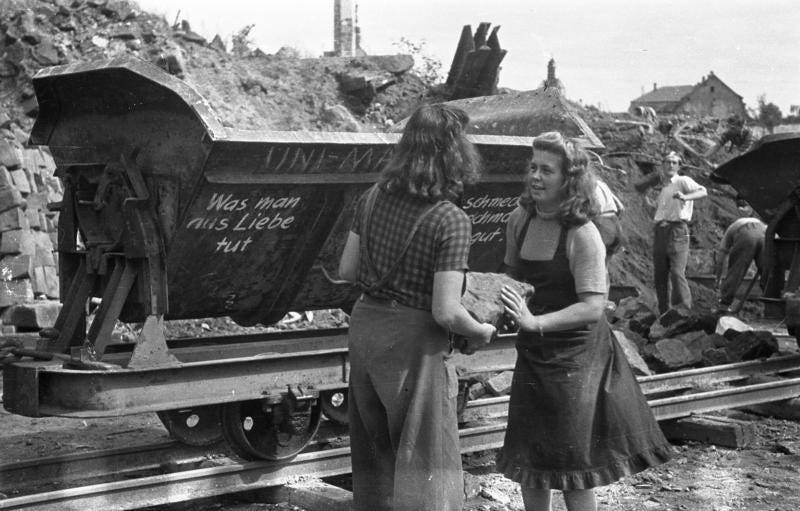
When the Deutsche Oper Berlin (then still the Städtische Oper) staged its first performance after the war, before the 1961 Giovanni reopened the renewed opera house (itself an architectural manifestation of distance, a protective barrier of concrete and glass), it chose to stage the work that had first opened the house in 1912: Beethoven’s Fidelio. It’s not only the story of redemption, freedom, and salvation, but also a story of a woman taking on the work of a man in order to make it happen. Leonore becomes an avatar for the rubble women (“Trümmerfrau”) of Berlin. In fact, one image I came across of two Trümmerfrau at work features a waste receptacle in the background that reads, in part, “Was man aus Liebe tut” (what one does out of love). It’s an apt echo of the original subtitle for Fidelio, “Der Triumph der ehelichen Liebe” (the triumph of marital love).
It’s not a perfect metaphor (the Nazis, after all, not only coopted Beethoven but also clung to Fidelio as a metaphor for their own hopeful victory and transcendence). But it’s a perfect mirror for the moment in time. Warts and all.
Coda
Even context deserves context: For another side of the myth of the Trümmerfrau, check out this 2014 article from Deutsche Welle.