

The New Imperial Spectacle
On Arizona Opera's generative AI “Aida”
In a third-season episode of Killing Eve, the show’s title character — an MI6 agent tangled in a political intrigue that has earned her a near-fatal gunshot wound and killed several of her close friends and colleagues — is counseled by a new-to-the-game colleague, Mo. “You really should have some kind of protection,” he tells her. She quietly scoffs.
“Do you have any idea what happens to people who are protected by MI6?”
“What?”
Eve walks away, then turns around for a moment, laughing: “It’s not good!”
I love this scene for its messiness and its economy. Eve could have given Mo a full speech. Conversely, she could have said nothing at all. Instead, she delivers three perfect words. As a writer, I know I should be concerned about how automation may make my job redundant, but when I plugged Eve’s same question into ChatGPT, I received a 300-word response that didn’t say much.

It was nice to be reminded of this amid so much of opera falling to the Enshittocene, a phenomenon my friend and colleague Hugh Morris has covered recently. Beyond AI-generated marketing designs and ChatGPT-authored website copy, generative AI has also begun to work its way onstage as well.

This progression is inevitable: “How can we pretend that AI isn’t going to encroach on the art we create?” director Yuval Sharon asked last year in an Opera America article. It’s an idea he expanded on earlier this year with a production of Così fan tutte for Detroit Opera that recast the four lovers as Ex Machina–esque creations from Alfonso’s laboratory. In Sharon’s view, however, this was more about the centuries-long push towards AI, the groundwork for which was laid by the same Enlightenment-era ideas that Mozart and Da Ponte brought to their school for lovers. For this reason, and in alignment with the ambiguous ending to the opera itself, his staging was designed to be ambivalent towards the technology, seeing in it a Promethean level of both transcendence and catastrophe. “We have to just grapple with it,” he told San Francisco Classical Voice.
Other productions, however, seem to have more readily gotten past the grappling phase. Opera Baltimore and OperaDelaware’s coproductions of La traviata and Rigoletto, both designed by Jefferson Ridenour, saw initial concept images generated via AI. Last year, Mission Opera shared an increasingly baffling set of AI-generated images — and, in one case, an AI-generated staged video — of Madama Butterfly, which prompted enough outcry that the AI-generated costume sketches were apparently deleted (the video, along with other images like AI-generated set concepts, remain online) and led to statements posted by both the company and director Christian Francesconi Catena.
While the first letter is more or less boilerplate for what we expect from an institutional apology these days, Catena’s is worth a read as a study in apologia versus apology. As a fan of Barthes, my favorite part is when he implies that his work on the generative costume renderings had been “judge[d] without understanding the author’s intent or discerning the act from intention,” adding that this was “a form of discrimination itself.”
Ironically, this mirrors a letter sent from Verdi to Camille du Locle in 1869: “Everyone wants to judge according to their own ideas, their own tastes, and, what is worse, according to a system, without taking into account the character and individuality of the author.” With this progression in mind (a progression I can safely guess AI is, for the time being, incapable of replicating), I wonder what Verdi would or wouldn’t make of generative AI making its way into his own operas. Recently, Arizona Opera announced that its concert performance of Aida would be accompanied by “the backdrop of a visually stunning first-of-its-kind feature length Generative-AI film.”1
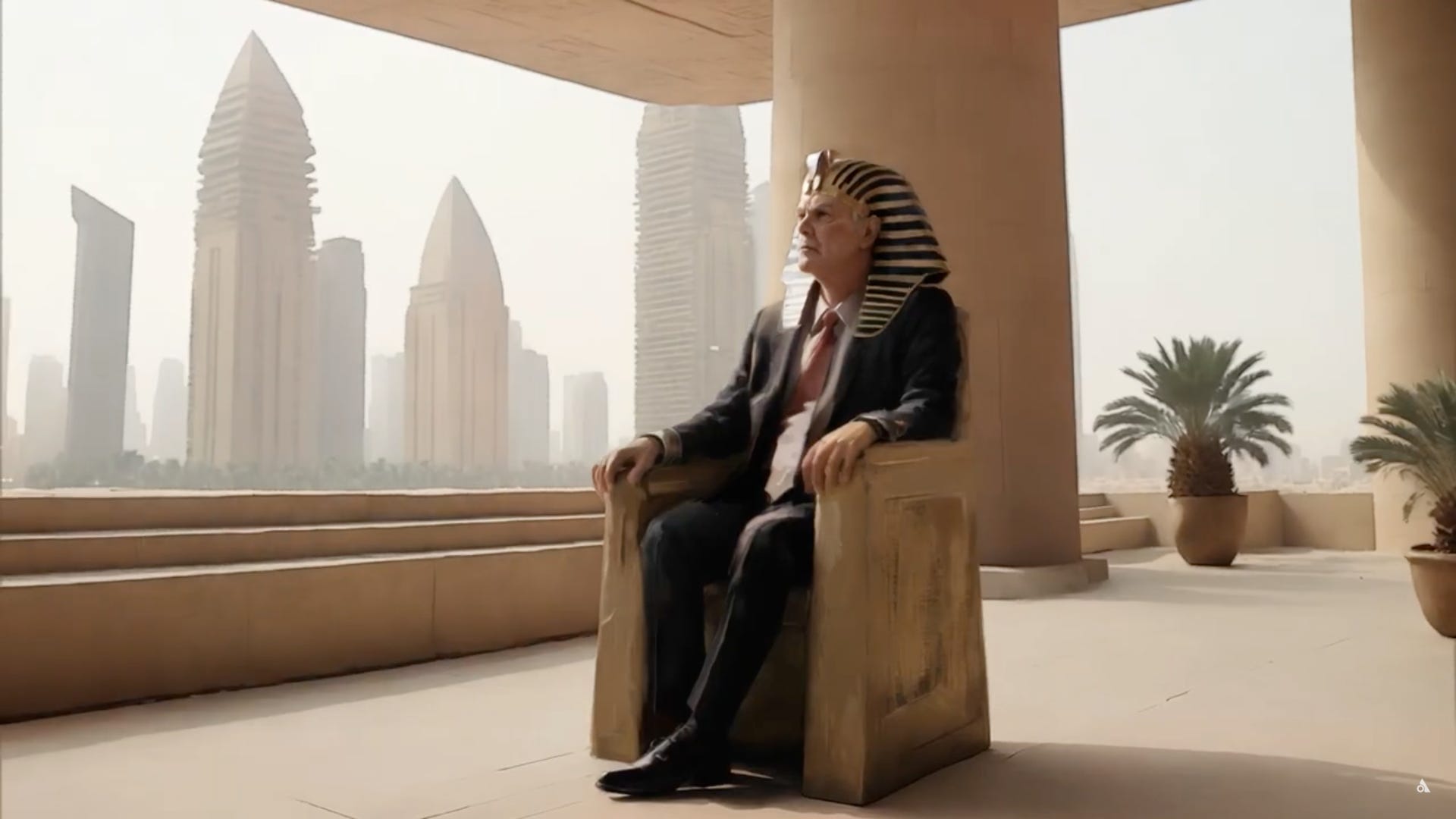
“I see AI and opera as this massive opportunity,” director David Murakami says in a promotional video for the production.
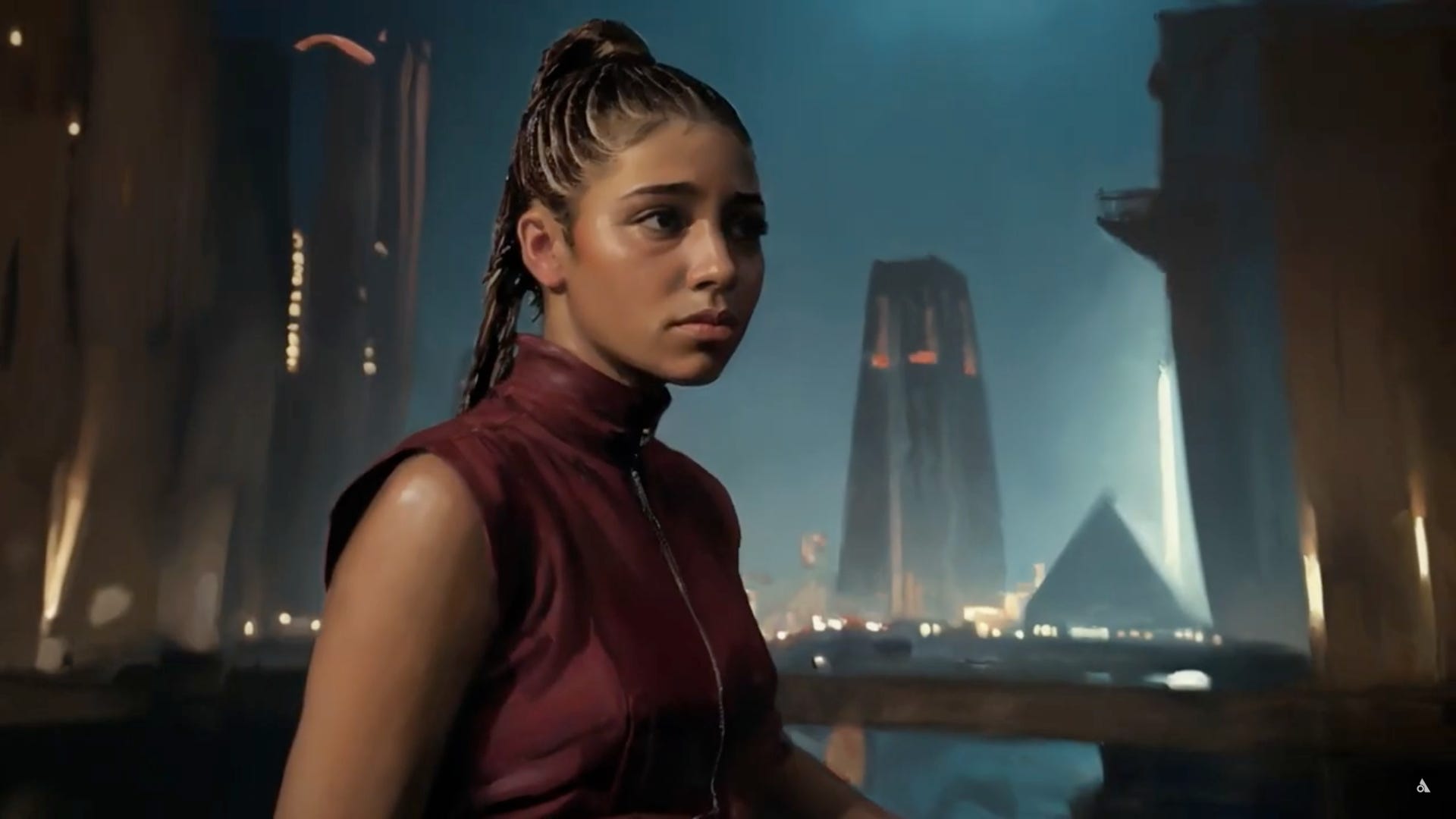
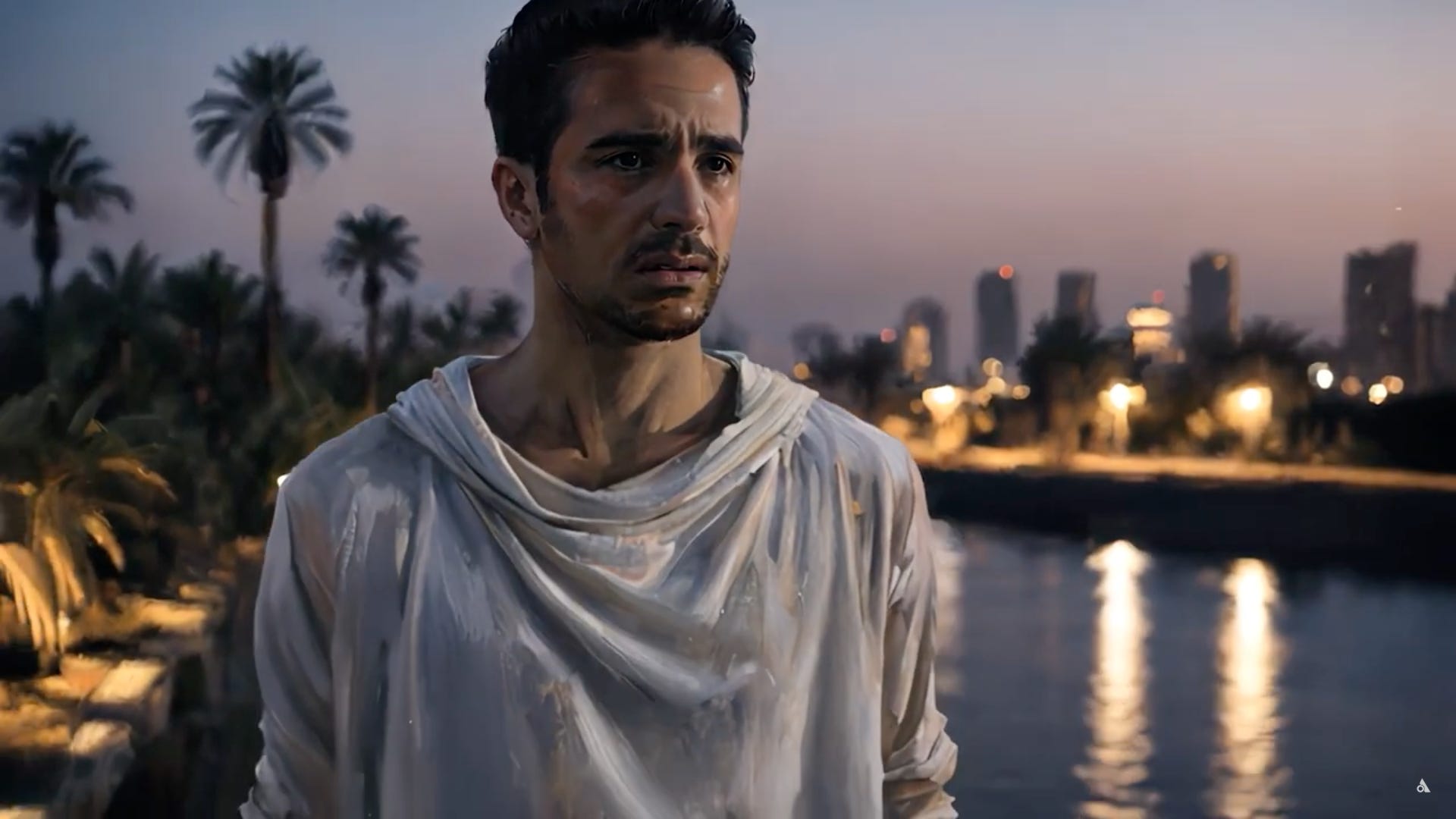
This pitch is set against previews of the film that look like a patchwork of cinematic blockbusters (Black Panther, Dune, Blade Runner) rendered in that uncanny valley style of generative AI. There are layers of “ancient” and “modern” Egypt, exemplified in a visual of what appears to be the King of Egypt in a crisply-tailored business suit paired with a nemes, seated against a backdrop that looks more like Dubai than Cairo.
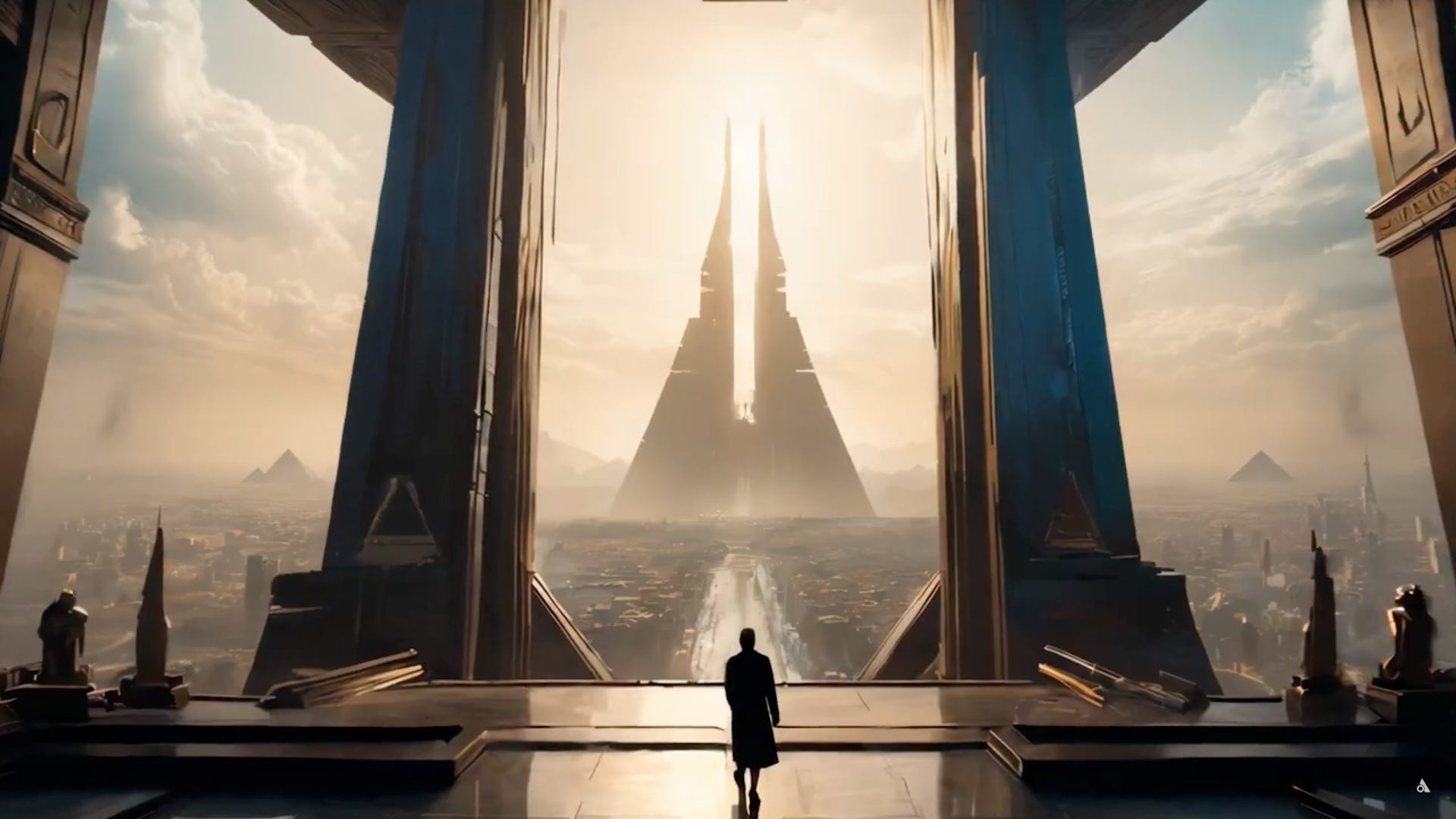
This confusion of place is reflected in a later image of one character looking out across a cityscape of scattered pyramids and a building that looks more like Burj Khalifa than anything in Cairo’s skyline. (I reverse-image-searched a screenshot to see if I was missing any architectural landmarks in Egypt, but all that came up were other AI-generated buildings tagged with keywords like “dark” and “futuristic,” plus a scene from Mortal Kombat Deception.) While the people depicted in the video seem to be related to characters from the opera, none resemble any of the cast members. It is, in the words of Eve Polastri, “not good.”
On the other hand, it’s also not so out of step with Aida’s points of origin. At once manifestly Egyptian and categorically not, the work grew out of a time where the country’s national identity was in flux. “My country is no longer in Africa, I have made it part of Europe” said Khedive Isma’il Pasha, the viceroy of Egypt who commissioned Aida for an Italianate opera house he had built in Cairo over an aggressive timeline of six months. This came roughly 70 years after the Napoleonic conquest of Egypt which, as Edward Said writes in his own essay on Aida, motivated in part by the desire to “put Egypt before Europe, in a sense to stage its antiquity, its wealth of associations, cultural importance, and unique aura for a European audience.”
This period of plunder gave us the concept known as Egyptology — a study of Egypt by Europeans, for Europeans, that had very little to do with the country itself. At the same time, Isma’il Pasha was happy to sell out his people in this manner (and more) if it meant that he could establish a Paris-on-the-Nile, finding an alliance with European powers to be more advantageous than one with the Ottoman Empire (of which Egypt was still an autonomous region). It is a French Egyptologist, Auguste Mariette, who is credited with developing the original plot for Aida.
In a similar way, despite being one of his most enduring works, Aida is not a typical Verdi opera. While Verdi had an affinity for personal dramas cast against the backdrop of political turmoil, Aida feels out of step with comparable earlier works like Nabucco, I Lombardi, and Attila — all of which were written for Italian audiences during Northern Italy’s fight for political sovereignty. This war of independence would eventually lead to a broader political movement uniting the entire Italian peninsula, a cause that Verdi ardently supported. He was less invested in the cultural identity or political future of Egypt, “a country which once had a greatness and a civilization I have never been able to admire,” as he told du Locle in 1868.
To this end, Verdi had turned down Isma’il Pasha’s invitation to write an opera for his new opera house in Cairo. Twice. He eventually capitulated when the Khedive agreed to his exorbitant fee of 150,000 francs, a little over $1 million today.2 “If you ask them for one of [the pyramids] as a bonus (the biggest, of course), they may be inclined to give it to you,” du Locle wrote him in 1870, amid mounting pressure to lock in a commission.
Working on the score against the backdrop of the Prussian Siege of Paris (a city that in certain ways had become a second home for the composer), didn’t help with Verdi’s ambivalence. “My opera for Cairo is finished, but it can’t be performed because the costumes and scenery are still held up in Paris,” he wrote to the sculptor Vincenzo Luccardi at the end of 1870. “It doesn’t matter much. What does matter is this terrible war, and the advances these Prussians are making, which may be fatal for us later on. It’s no longer a war of conquest, but of senseless ambition. It’s a racial war, and it will last a long, long time.… let us have faith in the stars that rule Italy’s destiny, rather than the men.”
A similar script was playing out in Isma’il Pasha’s Egypt, an empire that would fall apart a few years after Aida’s premiere following a disastrous war with — of all places — Ethiopia and a rebellion that would lead Isma’il into exile (first in Naples, and then in Istanbul, where he reportedly died trying to down two bottles of champagne in one go). While feeling the effects of one war acutely, Verdi was, consciously or not, contributing to the soft power of another empire doing the same, underlining Said’s assertion that “the embarrassment of Aida is finally that it is a work not so much about but of imperial domination.”
This dovetails with one of the roles AI is currently playing in our world, one hinted at when Murakami, a film director and projection designer by profession, calls the introduction of this technology into opera “an opportunity.” On his own website, he describes himself as “a trespasser, questioning the barriers we erect between media… [M]y eagerness to destroy is built upon a purpose of preservation.” It’s the sort of adventurous, disruptor language that mirrors the justifications used by Napoleon’s archaeologists, and one that is in step with the ways many tech professionals describe AI, particularly frontier AI.
“America’s experience with frontiers is fraught, to say the least,” Nathan Sanders and Bruce Schneier wrote in an article for Jacobin last year. “That history has something to teach us about the material consequences we can expect from the promotion of AI today. The race to build the next great AI app is not the same as the California gold rush. But the potential that outsize profits will warp our priorities, values, and morals is, unfortunately, analogous.”
In many ways, particularly the cultural shift that shook Silicon Valley at the beginning of this year, we are already seeing the realization of that potential, as well as the effects of the warpage. Karen Hao is right to point out in the MIT Technology Review that AI is not in pursuit of land in the same way that colonial powers were in previous centuries, “the seme desire for profit drives it to expand its reach,” while developing “new ways of exploiting cheap and precarious labor, often in the Global South, shaped by implicit ideas that such populations don’t need—or are less deserving of—livable wages and economic stability.” This is exemplified by a recent petition filed with the Kenyan Government by five former contractors with OpenAI, who (along with 46 colleagues) were paid between $1.46 and $3.74 an hour to moderate extremely graphic content used to train OpenAI’s models. OpenAI then terminated the workers’ contracts eight months early. “We were left without an income, while dealing on the other hand with serious trauma,” said one petitioner, Richard Mathenge.
The environmental impacts will also carry the greatest burden for those with the fewest resources on the frontlines of the climate crisis. By OpenAI CEO Sam Altman’s own admission, the industry is heading towards (if not already in) an energy crisis. Scientists estimate that the power requirements of North American data centers doubled between 2022 and 2023, in large part due to the rise in demand for generative AI. Between 2021 and 2022, water usage went up by 20% and 34% when Google and Microsoft, respectively, pivoted to similar technologies. Researchers from UC Riverside and UT Arlington estimate that, by 2027, the global water demand for AI will account for 4.2 to 6.6 billion cubic meters — roughly half the annual water withdrawal for the United Kingdom, and four to six times that of Denmark.
So far, the benefits of the technology have not been democratic. Simon Johnson, one of the 2024 Nobel Laureates in Economics, draws a straight line from colonialism to artificial intelligence. Comparing AI to the ships that brought Europeans to resource-rich colonies, Johnson notes that the technology itself is more benign; it could, he argues, point to a better, more inclusive world. But if history has taught us anything, it’s that no technology is democratic once it gets in the hands of humans and becomes a tool for power.
Opera itself is a similar technology, one that was born in the living rooms of wealthy Florentines, but one imbued with the egalitarian, humanist quality of the Renaissance. Venice’s opera houses democratized the art form further, making it accessible to the public rather than just those who could afford to put on a performance in their own homes. It has been volleyed between these two class contexts ever since. Like many composers before him, Verdi was caught between both. How apt, then, that his opera most explicitly linked to power is also the one that, in Said’s words, “ends in hopeless deadlock and literal entombment.” Musically, there is no Verdian punctuation mark, but rather a fade into the ether as the lovers run out of breath. Aida and Radames don’t simply die — they are buried alive.
Focusing on the work’s two female characters instead of the lovers, Catherine Clément expands this deadlock and entombment to include Amneris who, defeated by the plot of the opera, also ends “locked up in the temple,” and in the systems of autocracy and imperialism to which she is also subservient.
It’s easy to map all of this onto the current power dynamics within our society, as seen by many of the modern-dress productions of Aida that are staged today (certainly the long-term fallout of the collapse of Khedivate Egypt, in the wake of Isma’il Pasha’s excesses and ambition, are still being felt today — especially in Sudan and South Sudan). One could even take a Sharon-esque look at how technology, as a tool for imperialism, could be used in exploring this story’s continued relevance. Just this week the Trump administration announced it will be using AI to deport pro-Palestinian student protesters.
Instead, Arizona Opera has chosen to invest time and resources into an Aida that is more closely aligned with the original material circumstances of the work’s creation. In that way, AI-Aida is the true ideological inheritor to the opera’s roots: a patchwork of references, lackadaisical history, and a hazy spot in the venn diagram between culture and politics. The problem with this level of historicity is that we have the benefit of just over 150 years of hindsight, with nothing in the way of plausible deniability. We know what happens when we get into bed with imperialism.
It’s not good.

For his part, even Verdi, who liked to fashion himself as the son of illiterate peasants*, seemed embarrassed by this fee being accepted, writing to Emanuele Muzio in the summer of 1870: “We must at least keep the fee secret, since it would serve as a pretext to disturb so many poor dead men. Someone would be sure to point out the 400 scudi for the Barbiere di Siviglia, Beethoven's poverty, Schubert's misery, Mozart's roaming about just to make a living, etc.”
*Verdi was, more accurately, the son of middle-class landowners.
Nicely put. I'm surprised the link between AI and imperialism is not more frequently made. I grew up believing that the British installed railways in India for the benefit of Indians; only later in life did I learn they were used to systematically loot the country. An LLM 'training' on copyrighted materials is - to my mind - looting. Of course, those with wealth have more means to defend themselves from looting.